March 23, 2011

Putting Turkey on Berlin's Map

Gözleme - Neukölln

Imagine the following conversation taking place in German:
Me: „Let’s go for food.“
Some blond person: „Sure, any suggestions?”
Me: “There’s this nifty Turkish place down the road…”
That blond person: “I thought you meant real food? I’m not in he mood of having Döner right now.”
Me again: “Urgh… I didn’t mean that either. I was talking about going to a restaurant.”
A bewildered blond person: “Yeah, but a Döner on a plate is still just a Döner, right? I think I’ll pass. I need real food.”
An irritated me: “But… like… a restaurant? With real food? Cooked and all? What’s not real about that?”
An irritated blond person: “Listen, let’s just do something else, I told you I didn’t feel like going for a kebab.”

That dialogue of the deaf can go on pretty much the same way for a couple more minutes before I end the discussion with a sigh and lead the way to the warm embrace of the closest Schnitzel. Not that Schnitzel is bad. I love Schnitzel. But I’ve always found Teutonic disinterest regarding Turkish food to be quite baffling.

As true as it may be that food can be overrated as a sign of entrenchment of genuine multicultural understanding in any society, it’s still bleeding important on an everyday level. In some ways, it’s always the first contact between people, an excuse to start talking to each other and a symptom of people’s readiness to test their own limits and boundaries. Which is why I find it so strange that the Turkish cuisine – although so present in Germany – has not yet been embraced by most Germans to be included into the local food culture, as is the case in France with couscous and in Britain with curry.

The thing about the Turkish cuisine is that it is strikingly rich, encompassing a whole myriad of dishes, shapes and tastes. Yet ask any of the inhabitants of the largest Turkish city outside of Turkey whether they know any Turkish food and most will not get anywhere past Döner. And let’s face it, Döner isn’t even that Turkish, being a local creation invented around Kottbusser Tor. And still, Berlin offers a range of many good Turkish places. The trick is to find them.

Gözleme in Neukölln was initially a friend’s tip. One of the few traces left by an unspectacularly boring relationship with a Turkish ex was a love of Turkish pastries and dough-based dishes. Two of them are Gözleme – the Turkish version of a crêpe – and Manti – the Turkish dumplings. She said we could find both on Karl Marx Straße.

At first glance, the place is barely distinguishable from any Döner joint in town, just a bit larger. This impression is heavily influenced by the fact that the décor is a marriage made in hell between radioactively yellow walls, in-your-face lights and a touch of pink whenever possible. But there is a real menu, the spinning kebab is nowhere to be found and the owner of the place is incredibly nice and welcoming.

The menu is not overwhelmingly large. It offers a fairly limited choice of soups, a never-ending list of gözleme, two different manti and a couple of meat dishes from the grill. We decided to concentrate on the doughy options and started by ordering a lentil soup (2.80 €) and an aubergine gözleme (that Turkish crêpe for 2.50 €) to start the meal. One has to remember that the lentils in Turkish lentil soups are pureed, giving the soup a very smooth texture. Unfortunately, this one came out fairly bland at the end. It was still alright, but just not inspiring. The gözleme was far better: The dough was thin and the garlicky aubergine filling was superb. It was also large enough to serve as a main.

Lentil soup
 We then continued to our main courses and ordered manti for each, but one dish was vegetarian (with potatoes, 5.50 €) and the other had a meat filling (for 6.50 €). Manti are basically dumplings the size of a dice. Their size is probably one of the biggest challenges when it comes to their preparation, as it is very easy to either stuff them with too little filling and just taste dough or to stuff them with too much and to miss the point. They are served swimming in a yoghurt-garlic sauce. The meat manti were just perfect. The dough was good and the filling had a strong presence despite its miniscule size. The yoghurt-garlic-pepper sauce was so good I did not mind leaving the place smelling like a vampire slayer. The vegetarian manti were, unfortunately, a bit of a disappointment. The sauce was just as good, but the dumplings were fairly watery and the filling did not taste of much. It was still alright, but it felt like eating slices of dough swimming in yoghurt-garlic sauce, which is not as spectacularly good as eating delicious manti.

Gözleme
Manti

 I’m being fair here and rewarding gözleme with three prints because the bland soup and the watery vegetarian manti were far from perfect, but it doesn’t mean the place isn’t good. It is quite marvellous if you know what to order and feel like having a simple, hearty and inexpensive meal. Otherwise, in case you live and Berlin and have never tasted gözleme or manti, just go there without thinking twice (and when I say gözleme, I do NOT mean those greasy atrocities they sell at the Maybachufer market).

Overall mark:


Gözleme - Türkisches Restaurant
Karl-Marx-Str. 35, 12043 Berlin
Tel: +49 (0)30 613 4134


View Larger Map

March 15, 2011

Eating Trolls

Munch's Hus - Schöneberg

Don’t you just miss these days when everything was clear-cut and easy? When the world had a clear set of rules and you knew what was right and what was wrong? Girls wore pink; boys wore blue and all that jazz? That certainty is bound to cave in at some point, whether we like it or not. The interesting part is what triggers the moral meltdown.

I remember my serene world of infantile certainty collapsed because of trolls. Trolls, you ask? Well, yes, trolls. As a child I understood trolls. I did not much like them (I was a mainstream kinda boy, rooting for the good guys and disliking ugly, hairy creatures with warts the size of a tuna sandwich, whether they were real trolls or just that dodgy guy who used to haunt Digbeth Coach Station), but I got their essence. They were big, revolting and scary. And most of all – they had a purpose in life, which was just that, to be perfectly hideous and then be slain by the good guy. And then came the 90’s with their strange deviations. Do you remember those little plastic trolls with the neon-coloured hair that suddenly invaded every school class on the face of the planet? They were all about being sweet in a revolting kind of way, with nostrils the size of half their faces. If they were real trolls, these nostrils would be hairy, but alas, those colourful look-alikes had nothing natural about them, and hairy nostrils were definitely not cute. Suddenly every child in the country was obsessed with those little dolls, and I could not get to the bottom of it. Why on earth?

Nearly twenty years later, I had a troll flashback on a flight between Paris and Oslo, as I had the pleasure to sit next to a French Erasmus student who happened to be going back to Oslo after spending Easter at her parents’ in the Bauce. She was happily ranting about the woes of a Frenchwoman forced to spend a year in the Norwegian wilderness: no baguette, no cheese, and the rest of the food is so bleakly horrid. “It tastes like eating trolls, you know?” She pouted her lips before she continued, “but Norwegian trolls, not real ones.”
“Real ones?” I asked, “Aren’t the Norwegian ones real enough?”
“Oh no, real trolls are so cute! You can play with their hair for hours!”
How could I forget? The Erasmus students of today were born in the 90’s. For them trolls are no Norse mythological beings, but rather toys made in China. And yet the girl had a point: Food in Norway often felt like biting one’s way through a troll. It wasn’t that the food wasn’t good on paper, but it usually ended up being served without the slightest hint of seasoning for the price of three meals in any other country. With all of my awe and admiration for the country’s stunning natural landscapes, the best thing about eating there was usually nibbling on the sandwiches I had prepared in Sweden before crossing the border. I was therefore intrigued when I heard there was a Norwegian restaurant in Schöneberg which was supposedly wonderful.

Munch’s Hus is located directly on the Bülowbogen, an area which might as well be recognised for what it is: A sterling example of West-Berliner utter desolation. As we entered the restaurant, the 90’s hit us again, and not from its brilliant Ace-of-Base angle. Even though it was aiming for upscale, the overall deco was far from being a success. With radioactively yellow walls, bright lights and reproductions of Munch densely covering the walls, I had to sigh disapprovingly before taking a long look at the menu, which was endearingly didactic with random pieces of information about Norway and Norwegian food. Slowly, I felt the Scandi-phile in me gaining the upper hand. The yummy Norwegian food I never got in Norway seemed to be accessible in Berlin for about a third of the price I’d have to pay in the land of fjords and trolls.

We started with a Nordmeersuppe (North Sea soup: a creamy soup with prawns and lumpfish caviar for 3.90 €) and a Rondane-Teller (we’ll call it the Norwegian antipasti mix: a mixture of elk and reindeer sausages, Norwegian cheese and a scrambled egg for 5.90 €). The soup was surprisingly perfect. I am not the biggest fan of cream soups, as I think they have the tendency to end up being just stodgy, but this one was good. It was delicate, had the perfect texture and most important: the cream did not cover up the taste of the other ingredients. The Rondane plate was also quite a success. It was a mixture of the best Norwegian products one can find, with meat and cheese stuff that incorporate a wide array of different tastes.

Elchbraten
Kveite
 We then continued with the Elchbraten (elk roast with potatoes, lingonberries and chestnuts, 16.90 €) and the Kveite (halibut filet in blueberry sauce with leeks and potatoes in saffron, 13.50 €). The roast represented one of Norway’s eternal culinary woes: it sounds a lot more exotic than it really is. The sauce was delicious, but elk never really tastes that good. We’re talking about very muscular animals here, and their meat in accordingly stringy. It was good, but not fantastic. On the one hand, it was to be expected, but on the other, it would mean other elements of the dish would just have to make up for it, which the potatoes and the relatively boring chestnuts did not do. The halibut, however, was a different story altogether. The fish was tender – not to raw and not too dry, while the blueberry sauce was very exciting indeed. I guess not anyone would fall for this dish because of the sweet and sour touch of the blueberries, but if you are into experimenting, it will be worth your thirteen Euros.

We then both decided to take the same dessert: crème caramel with cloudberries (for 5.10 €). Now, crème caramel is a fairly boring choice, I know. And the pricing might also seem a bit odd. At least until you take a closer look at the second ingredient: cloudberries, my friends, are probably the last remains of heaven of our little planet. They are one of Scandinavia’s true treasures: they look like golden raspberries and taste like…well… heaven. In Scandinavia, they are usually found in diluted form (jams, ice cream, etc.), partly because the fruit itself is so expensive and partly because it has such a strong taste. My pure enthusiasm upon finding a dish with real cloudberries was unimaginable. Alright, you can’t get any fresh cloudberries in March. And even if you could, you would pay more than 5.10 € for them. But I even enjoyed their de-frosted version (oh yes, and the crème caramel was good. Unspectacularly so, but it was perfect for what it was).

The marking business with Munch’s Hus is fairly tricky: the service was excellent, the pricing was very good and the food was good – from fantastic to just nice. The problem with the “just nice” was the fact that it was their house speciality (the elk roast). And then you’ll have to add these horrible yellow walls and yellow lightning (which ruined the photos this time around. My apologies indeed). Alas, Munch’s Hus will be awarded with only four prints, knowing it has what it takes to make it to five. Go there. It’s good.

Overall mark:
Munch's Hus
Bülowstraße 66, 10783 Berlin
http://www.munchshus.de


View Larger Map
March 04, 2011

Curry Cravings No. 1: The Sri-Lankan Option

Chandra Kumari - Kreuzberg

A couple of months ago I was reprimanded for being negative. It was a dark mid-winter Berlin afternoon, so who wouldn’t be? Yet it was not the first American (actually, the girl in question was Canadian, but please bear with my blunt generalisations for the sake of the argument) telling me off for exuding an aura of negativity. Not that I care much, but now that spring is coming and I even got to see the bottom of a crocus this morning, I decided it was about time to try a more cheerful, positive approach to life and other people around me, and there is no better place to start than right here.

At any event, gushing glee was my initial plan. And then I remembered I was going to write about curry in Berlin and realised it was not going to happen. Now you see, I am curry’s biggest fan. Nothing makes my day like a good curry, and in fact, I like it so much that I can even settle for a mediocre one. It’s just that curry in Berlin usually manages the task of falling short of mediocrity, being simply atrocious.

Let me guess, you’re sitting in front of your iBook, frowning and calling me a food snob? You may have a point there, but it still doesn’t make the local curry any better. In my first year in Berlin I sampled 61 Indian places and did not find a single one that served edible curry. The sauces were usually very heavy instead of light and nearly always sweet where they were supposed to be spicy. More than once I even ordered a naan just to receive something that looked like Camilla Parker Bowles’s grin strewn with Gouda. Have I mentioned the Vindaloos on the base of cream? Or the sweet Madras? I could go on for hours on end with examples of more and more crimes against the virtues of Indian cuisine. The bottom line remains the fact that Indian food is Berlin’s biggest black hole.

You can therefore imagine my reaction when a friend of mine told me she had just had the perfect organic Sri Lankan curry at Chandra Kumari on Gneisenaustraße. I did not believe her, but decided to try it out. A few weeks later I went there with a friend, who was as sceptical as I was. It was the middle of the week, but we found the small space full, with a single small table awaiting empty at the corner. Surprisingly enough, we were not greeted with an overdose of gold and glitter. The number of Buddhas was kept to a minimum and the wooden furniture was aesthetically pleasing, even though not entirely comfortable.

Hoppers and Curry
Rice Platter

We started by sharing a dish of four “hoppers” accompanied by a beef curry, described as the Sri-Lankan speciality (for the price of 6.90 €). We did not know what hoppers were, but discovered they were a bready dish that looked like Jewish skullcaps (or German müsli bowls, whatever you find more appetising). They are thin and crispy on the sides and thick and soft in the middle. Their overall taste was fairly unspectacular, but we both enjoyed the novelty and the texture. As they are supposed to be eaten together with curry, we turned to the brown mass that was served with it for inspiration. At first it looked interesting. The sauce was brown and did not look like the yellow mud one usually meets in Berlin. Its taste was nice, but far from convincing. It was still better than any other curry I had eaten in Berlin before, but it remained fairly bland nonetheless. One positive thing to be said is the fact it was a lot more refined the usual Berliner curry.

As we turned to explore the menu for main courses, we realised most of it was fairly generic, with “curry”, “madras” and “biryani” in most categories. At the end we ordered something called Reistafel (rice platter – four small curry dishes with basmati rice in the middle): one was the “chicken platter” (it contained a chicken curry dish, a dahl – lentil curry, aubergine curry and a sambal salad with rice and pappadums for 12.10 €) and the other one was the “lamb platter” (containing one lamb curry, bean curry, cabbage curry, sambal salad, rice and pappadums for 12.90 €). The curries were fairly different from one another. The chicken curry was absolutely bland and fairly tasteless. It had a bit of the beef curry’s taste and lacked a spicy tone along the same lines. The lamb curry, however, was quite good and had a nice twist of ginger. Both sambal salads were tasteless with a strange texture and the aubergine curry was strangely stodgy. The dahl and the bean curry were nice, but again – bland, whereas the truly positive surprise was the cabbage curry, which was rich without being too heavy and had a taste which was both spicy and refined.

At the end of the day nothing was truly abhorrent as curry in Berlin tends to be like. There were no disgustingly sweet or embarrassingly stodgy experiences. The worst thing to be said about some of the dishes would be that they were fairly bland and thus uninspiring, but the overall quality was still a lot higher and each dish a lot more refined than what I had to get accustomed to around here.

Overall mark: 


Chandra Kumari - Originalküche aus Sri Lanka & Südindische Spezialitäten
Gneisenaustraße 4, 10961 Berlin
http://www.chandra-kumari.de


View Larger Map

February 21, 2011

The Babushka Vibe

Matreshka - Friedrichshain

I must have been about five or six when I made an unfathomable discovery. It was a hot summer day at my grandmother’s and I had just eaten a revoltingly radioactive-looking banana ice-cream bar. My hands were sticky, my face smeared with yellow substance and I was holding a stick I needed to get rid of as soon as possible. As I stepped into the kitchen and pulled open the lid on top of the rubbish bin, a deeply disturbing scene unfolded in front of my impressionable eyes: the bin was full of dumplings that looked just like pierogi.

The gravity of the matter would surely be obvious to anyone who has ever come across a Polish grandmother. I will spell it out for all the others: pierogi, or Polish dumplings, are nothing less than sacred. Not only is it unthinkable to throw them away, it is a sin to even contemplate any such nonsense. Needless to say, I was baffled. Had an unspeakably hideous crime just taken place in the very kitchen I was standing in? I looked around, hoping it was not a trick to get me framed for pierogi-murder, and as I realised the kitchen was empty, I began screaming and ran to the other room, where my grandmother was leaning over a newspaper with a cigarette in her hand.

“Who threw away those pierogi?!” I cried. I must have gesticulated convulsively to stress my state of distress.
“Pierogi? What are you talking about?” She asked and seemed nearly panic-stricken for just one moment before realising what I had seen. Her nerves brought under control once again, she curved her lips into a sheepish smile. “Those weren’t pierogi. Just Vareniky. Ludmila, that Ruski from the second floor, she made them. She had the nerves to bring them here into my kitchen. I tasted one of them and threw them into the bin. Tasteless – like the rest of their food.” She then coughed as if to show I should pay special attention to what she was about to say next. “Russian food is like the evil witch from Snow White: she just looked pretty, but was foul inside. By the same token, people like Ludmila from the second floor just make their food look like good Polish food, but inside, it is just tasteless.”

I therefore spent my childhood years knowing that Russian food was something I better avoid. It was only years later, long after my grandmother’s death, that I discovered that Russian food could be quite brilliant. What she said was not entirely untrue: more often than not, Russian dishes will be blander than their Polish equivalences. Vareniky are not as rich as pierogi, borsht is not as flavoursome as a barszcz ukrainski and generally speaking, there seems to be less spice used in the Russian cuisine compared to the Polish one. But do we really need to relegate pointless national aversions and comparisons to the culinary world? As this blog tries to promote world peace and eternal love, I will stop perpetuating negative culinary stereotypes and concentrate on all that is good and kind. In this case, it won’t even prove too difficult, as the Russian cuisine truly has a great deal to offer: think of a juicy shashlik (the Russian version of shish kebab, meat galore on a skewer), a hot salyanka (a thick and sourish soup) or just a bowl of pelmeni (meat dumplings) covered with heaps of smetana (sour cream)? I know it doesn’t sound healthy. But you’ll have to admit it sounds good. And this was exactly what I had in mind when I found myself craving Russian food last week.

Following a friend’s advice, we went to try out Matreshka in Friedrichshain. We found ourselves in the midst of a Russian birthday party, with a group of mothers dancing with their five year old girls to Russian Eurovision music. The walls were covered with colourful prints of large babushka dolls, but were otherwise so white and the place so brightly lit that I could not help but thinking of a Russian community centre in Dudley. The cheap IKEA furniture did not make things any better, and looking around, the feeling was of a place cheap and not entirely welcoming. And yet, for some reason it felt just right. It reminded me of Russia.

Beef Stroganoff
Goulash
 The menu confirmed my first notion, with a choice of very simple, home made Russian food for fairly low prices. We ordered two pints of affordable Russian beer (Baltyka, 2.90 €) and started our meal by ordering soups: a soljanka (a sour soup with tomatoes, gherkins and different types of meat) and a bortsch (beetroot soup), both cost 3.90 € if ordered as a main course or 1.90 € if ordered as a starter. The soljanka was nice, but quite bland. The bortsch was very good. It was not spectacular, but it reminded me of homemade soups in Russia. We then continued with a pork-goulash (don’t expect to get Hungarian or German goulash. Here it is made of pieces of pork in tomato-like sauce, 4.90 €) and the most expensive main course on the menu, the beef stroganoff (slices of beef in mushroom-smetana sauce, 7.90 €). There was very little meat involved in the dishes and they were not what you'd call visually appetising, but it was not very surprising considering the price, and therefore not the end of the world. The sauces were tasty and the overall quality was quite pleasing though – it was neither refined nor spectacular, but it was nice and felt like homemade creations of Ludmila from the second floor, or any other babushka for that matter.

To accompany our meal we also ordered a dish of mixed dumplings with 9 pelmeni and 7 vareniky (pelmeni are the meat-filled dumplings, vareniky are vegetarian, filled with potatoes or potatoes and sauerkraut, 9.90 €). Even though our bellies later came close to the brink of explosion because of the amount of dumplings and smetana we had stuffed into our poor mouths, it was well worth it. The dumplings were just brilliant: the dough was just right, the fillings were pleasing despite being bland and the smetana definitely provided us with much needed fat for the cold winter.

Overall, Matreshka is far from being a refined five-star restaurant. And yet, something about it was just right: it was a cheap place for those who get a sudden urge to get catapulted eastwards. The food is far from being perfect, but it is pleasingly and affordably authentic. Even the babushkas on the wall and the ghastly music in the background were much appreciated as a part of the drill.

Overall mark:
Matreshka 
Boxhagener Straße 60, 10245 Berlin


View Larger Map

February 17, 2011

The Berlin Blues: Does it Really Have to Be That Bland?

Good Morning Vietnam - Bergmannstraße

Bergmannstraße was one of the places I was introduced to through Nicole, who later got disqualified as a friend for sending out an e-mail in the first-person-baby to announce the newest addition to her family. I am not sure why I am even mentioning this, other than the fact it might be a shrewd analogy to the fact Bergmannstraße is the perfect street for parental visits.

Yes, whenever your parents come to Berlin for a any amount of time, be sure to take them to Bergmannstraße. It is a generically lightweight version of all that can be appealing about Berlin: It’s young, lively and accessible at the same time. It can be pretty, but not in-your-face-drop-dead-gorgeous. And most importantly, it appeals to a broader segment of the population, exuding a bit of Kreuzberg’s aloof coolness of the wannabe-multicultural and alternative kind without being filthy and run down. I doubt it you could find better examples for Berlin’s commitment to a healthy and relaxed lifestyle than a street composed of mainly cafés, healthy looking ethnic restaurants and organic shops.

Yet unfortunately, therein lies the root of the street’s inherent lack of appeal to yours truly without parental escort in tow. Yes, the Markthalle is really endearing and it’s always nice to have a street with so many things to choose from, but wait a minute: thinking hard, I really can’t name a café or a bar I truly like on Bergmannstraße: most seem to be ubiquitously unspectacular and inconspicuous. Moreover, most ethnic restaurants seem to embody what I often rant about in Berlin: bland dishes, toning down any trace of taste inherent to their respective cuisines to appeal to the broader Central-European sense of averageness. But then again, never say never and never let prejudice dictate your choices. Guided by these two principles, it was time to announce a new mission: let’s find redeeming elements on Bergmannstraße!

Following a friend’s suggestion, I realised nothing was more redeeming than finding a semi-secret restaurant in an inner courtyard, which is exactly what Good Morning Vietnam - an import from Mitte newly established in Kreuzberg - is all about. The estaurant shares its courtyard space together with a supermarket and an impressive number of bike-stands. In February’s bitter cold, the Japanese-looking exterior decoration with its various hanging lanterns and a wooden extension does not seem as welcoming as it must do in summer, when you could just sit outside in that sheltered inner-space and feel protected from the outside world. The restaurant also has a terrace – another summer element. I am sure you could all relate to my assumption, that I would already be a wealthy man if I had a penny for every time I said something in Berlin was “so much more beautiful/amazing/awesome/splendid in summer”? I am sure you feel the same way.

Yet at the moment we are unmistakeably still suffering under the yoke of the local winter, which will have to take us back to the warmth of the interior, which was promising, albeit not as inspiring as the lanterns and the wooden-vibe of the exterior space. The restaurant is divided into a few spaces, all very brightly lit and strewn with low tables. There are benches set alongside the glass walls, whereas those unfortunate enough to sit on the other side of the tables will need to come to terms with sitting on very low and not very comfortable stools. The general atmosphere is of a modern, inexpensive and yes – generic – Asian restaurant. The menu seemed to be quite promising though, serving a relatively limited offer of inexpensive Vietnamese dishes.

We started by ordering the vegetarian Nem Hanoi Deu Phu (cold summer rolls with tofu, rice noodles, eggs, herbs and a sauce for 2.80 €) and Nem Saigon (fried spring rolls filled with minced meat, served lukewarm for mere 2.80 €). The cold summer rolls tasteed of absolutely nothing. It felt like eating the fuzzy thing blandness is made of. Despite a general touch blandness, the fried spring rolls had a clear taste, and it was quite pleasant. However, they tasted of German meatballs rather than refined Vietnamese food.

Starters
Tofu

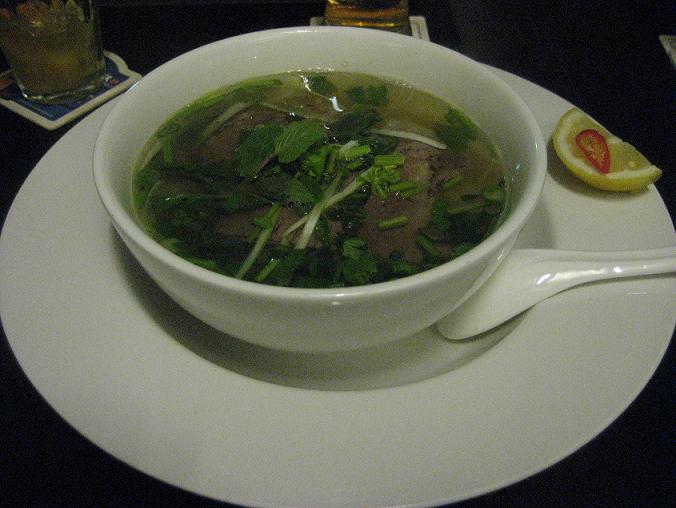
We then shrugged and hoped the main courses will improve our first impression. We ordered the Pho Bo (the clear soup you have to order at just about any Vietnamese restaurant, the bouillon can be either vegetarian, or as in most cases – based on chicken. This time it was beef for 6.90 €), Dau Phu Sate (a vegetarian dish with tofu and vegetables in sate sauce, 6.90 €) and the Ga Xoai (chicken skewers with sweet potatoes, vegetables and chunks of mango in mango sauce, 7.40 €). They came rather quickly and looked quite beautiful. The sauces all looked very appealing and the portions were not the smallest. Which was why we felt the bitter sting of betrayal when we had realised they all were all blessed with the same identical taste: blandness. Despite the different shapes and colours, these dishes had no taste whatsoever. The Pho’s broth tasted of the liquidy thing you get if you put Knorr’s mixture in a litre of water and stir. Even the 89 Cent ready-made glutamate-based Pho noodle soup from the Asian supermarket down the road is more inspiring than this soup (and I should know, this is exactly what I had to eat when I got back home.

Pho
Skewers in Mango

At the end of the day, Good Morning Vietnam is not BAD. It is just boring. I reckon bland food is better than bad food, but it doesn’t make it any more deserving of your hard-earned Euros. Go there in the summer for a cocktail in the inner courtyard if you want to appreciate its good sides. Otherwise, Berlin and Kreuzberg have more than enough Vietnamese options to choose from.

Overall mark:


Good Morning Vietnam
Bergmannstraße 102, 10961 Berlin
Tel: +49 (0)30 62 90 13 77


View Larger Map

February 10, 2011

Dancing on Tables? If You Say So

Ypsilon - Kleistpark, Schöneberg

When I was about six years old I asked my mother at some point why Greeks enjoyed breaking plates. “They don’t”, she answered with a grownup sigh. I sneered back and said I had seen them with my own eyes. And I was right. My easily impressionable nature was repeatedly traumatised by the loud gentlemen standing in front of Greek “tavernas” on touristy streets. All they seemed to be doing was to shout “ouzo” and throw an endless supply of plates with impressive force on the ground. For me it was clear there was something fishy about these Greeks and their strange affection to smashing objects. I could not fathom what on earth would cause a whole nation to live in a perpetual Birmingham-City-fan state of mind.

What I did not understand at the time was that some restaurant goers actually perceived this useless display of violence as exciting. And that was exactly what Greek restaurants in Northern Europe are all about: they sell an image of a land abundant in hot-blooded and colourful agitation that is so much more exotic than the drab gloom present in all of our everyday lives.

And then, when a friend asked me whether I wanted to try out Ypsilon on Hauptstraße (just off U-Kleistpark) because he had seen people dancing on tables there, my reaction was simply “I’m in as long as nobody’s going to break any plates”. Dancing on tables was exactly the right amount of excitement I could deal with: lively and utterly pointless. I could not quite call it exotic, as the only time I saw people dancing on tables had actually been actually in Warsaw.

Considering the fact I was lured all the way to Schöneberg under pretence of seeing people dancing on tables to the sound of a buzuki, the place was awfully quiet. Ypsilon has quite a large space and the overall design was rather tasteful compared to what Greek restaurants in Berlin usually deliver. No in-your-face bright lights, no pillars and no random Greek gods lurking around the place. This is not to say the place was entirely pleasing. The walls were too red and it felt like a mash-up of a cheap cocktail bar and a posh restaurant. A stage with a microphone was set in a central location, looming. A promise of live music and dancing on tables. It was still too early for that yet. We could concentrate on the food instead.

We started by ordering dolmades (stuffed vine-leaves, according to Chris the only true test of every Greek restaurant, 4.30 €), melitzana (mashed aubergines, 4.20 €), spanakopitakia (puff pastry filled with spinach, 6.30 €) and kalamarakia (pan fried calamari, 5.90 €). The starters came on large plates, decorated with fresh looking vegetables. They were also rather convincing on the quality end. The dolmades were not too sour and the rice filling was soft and nice. The aubergines were bland, as were the spanakopitakia, but they were not entirely bad. The calamari, however were even quite good. Not too rubbery and not too greasy. For pan fried calamari they were even rather pleasing.

The Wall
Starters

The main courses were a bit less convincing. We ordered a souvlaki arni (lamb skewer, 15.50 €) a bifteki gemisto (a piece of minced meat stuffed with feta, 10.90 €) and the moussakas (a dish not entirely unlike shepherd’s pie: a casserole based on layers of minced meat, aubergines, potatoes and cheese, 9.80 €). Generally speaking, the portions were very large and the presentation was appetising. The seasoning of all three dishes was also quite convincing. The only problem was the quality of the meat, which was lower than simply disappointing. It did not matter much in the case of the moussakas which is all about the sauce and the seasoning anyway. It had just the right consistency and the right touch of just about everything. It was no work of art, but it was thoroughly pleasing, even though a tad overpriced. The bifteki was fairly mediocre – with the meat not being exceptionally good, but it was still alright with the chips served on the side. The souvlaki turned out to be the main problem. When the entire point about a certain dish is eating chunks of meat off a skewer, you can’t really camouflage its poor quality with anything. Add the fact it was the most expensive dish on the menu and you’ve got stuff bad reviews are made of.

Moussakas
Souvlaki

As we turned to the perfectly friendly waiter and ordered the bill, we looked at the stage and the microphone one last time, feeling cheated and betrayed. The place had not become any more exciting or promiscuous, even though it was already long past 11. Without any dancing on tables to cloud my better judgement, I feel obliged to give Ypsilon three prints and feeling rather generous about it. It was not bad, but far from being good for the not-too-low pricing. Checking out their website I saw why we missed the action though: It says they have live music every Friday and Saturday after 11, but we went on a Sunday.

Overall mark: 


Ypsilon - Restaurant/Café/Bar/Sommergarten
Hauptstraße 163, 10827 Berlin
www.ypsilonberlin.de


View Larger Map

February 04, 2011

The Importance of Eating Kimchi

Madang - Korean Food

A few years ago I spent the evening sitting across the table from a South-Korean lady of sixty in a fairly nice Parisian restaurant. We were both waiting for my French aunt, who eventually showed up two hours later than planned. By that time we had been forced into making useless conversation about the weather, the restaurant and the French in general. The Korean lady was petite and fashionably dressed in white. She was wearing a white turban and was holding a white dog on her lap. Its white face had the shape of a white snail.

The one thing that kept the conversation going was our fantastic ability to whinge about nearly every possible subject: the sky, the noisy tourists at the other table or the low quality of French television. And yet, I thought she was taking it one step too far when she had started moaning about the bad food in France. I actually regarded food as the one advantage of living in France. When I finally asked what the problem was, her answer was just as cryptic: “No kimchi”.

“Kimchi?!” I thought. Yes, I knew kimchi and I had always liked it. But does lack of kimchi automatically disqualify any other cuisine? She nodded. “You’re not Korean,” she frowned, “you’ll never understand.” She then told me a story about how the Japanese uncovered North-Korean spies by serving large meals with a bit of kimchi in them. Most of the real Japanese around the table would sneer at the red stinky cabbage, while the North Korean spies – otherwise the perfect image of good Japanese men and women – would be the only ones who would devour it with unmistakable enthusiasm. “Alright, if you say so”, I shrugged.

After this conversation I also started developing kimchi-cravings. As I said, I had always liked Korean food, so it was not entirely new, but for some reason, it was only after the fashionable Korean lady’s stories that I started appreciating its due place in the pantheon of world cuisines. With time I learned that Korean restaurants were just about the best thing you could get. And for a long time, the lack of kimchi in Berlin stood as a symbol of the city’s culinary inferiority to food capitals like New York, London or even Glasgow and Stockholm. And then a few years ago something quite wonderful happened: Korean restaurants started appearing in Berlin. In order to start mapping Asia’s finest outposts in Berlin, we ventured out to Madang on Gneisenaustraße, just off Mehringdamm.

Tiny pancakes and noodles
Bibimbap

The inside is quite spacious and the ambience is a fairly pleasing middle ground between poshness and an Asian hole-in-the-wall that serves greasy noodles. The lights are a tad too bright and the chairs are a tad too reminiscent of furniture you got in the 80’s if you happened to step into any generic Chinese restaurant in the West Midlands. But then again, none of it is really disturbing. The waitress seemed to be overwhelmed by the job, but was otherwise professional, nice and helpful in a way you rarely get to behold in Berlin. The prices were all humane and the menu was large enough to be intriguing, yet not so vast it got confusing.

The first round was an array of starters, ordered both from the “appetizers” section as well as from the “sides” section. The waitress hinted the sides were just larger and better appetizers, and it turned out to be true. The Chljeonpan (tiny pancakes with five miniscule different vegetarian fillings and mustard sauce, 3.50 €) and the Chung mu Gimbab (three pieces of sushi-like rice rolls with a tiny portion of squids and radishes in spicy sauce, 2.90 €), both ordered from the “appetizers” section, were both nice, but too small and unspectacular to be really pleasing. The good thing to be said about them was that you got your money’s worth and the spicy radishes and squids were very good. However, the “sides” were a different story altogether. The Gogi Chanche (noodles made of sweet potatoes with vegetables and beef, 4.90 €) were very good and the Kimchijeon (pancakes with kimchi, 5.50 €) were nothing less than spectacular. They were soft and conveyed a myriad of different tastes. In fact, they were so good we found ourselves obliged to order another round of them.

The grill in all its glory
Ideally it would be eaten like that

For the mains we concentrated on two types of dishes: my beloved bibimbap (rice, vegetables, meat and egg all mixed inside a hot iron pan together with spicy sauce. I chose the “Imperial Bibimbap” or the Jeonju Bibimbap with beef and nine different types of vegetables for 9.50€. It is also available with tofu or with other types of meat and costs less. One can also get them in a boringly normal bowl without the heat factor for one Euro less. But what’s the point in ever doing that?) and the bulgogi (a grill dish in which you witness the meat grilled in front of your face and you can eat it together with various different sides. Madang offers a variety of grill platters for a minimum of two persons. Our table went for the Sabulgogi, or the beef grill for 13.50 € per person).

The portions were quite large in both cases. The main dishes came with fresh kimchi, marinated beans and marinated potatoes. Before I get to the description of the actual dishes, a word: the most important indicator for the quality of Korean food is the kimchi. And this one was perfect. The texture, the spiciness, the taste and that awful stench were all just right. The dishes were brilliant as well. I could have used a bit more spicy sauce for the bibimbap, but it was perfect otherwise: the size and the quality of all the ingredients were both just right, the pan was sizzling and it was highly enjoyable. The bulgogi was just as good. The cornerstone of a good bulgogi is the quality and taste of the meat. It scored well on both. High quality meat and fantastic seasoning. The meat came with rice and the aforementioned sides, while the whole lot was supposed to be stuffed into a leaf of lettuce. However, the meat itself was so good that we found ourselves eating it “freestyle” with the rice and the sides serving for pleasant distractions.

Bottom line: Go there. Good quality, good value. It doesn’t offer the posh experience other Korean restaurants do, but the quality of the food compensates for it. At the end of the day, very little compares to good kimchi.

Overall mark:


Madang
Gneisenaustr. 8, 10961 Berlin
Tel: +49 (0)30 488 27992


View Larger Map