February 21, 2011

The Babushka Vibe

Matreshka - Friedrichshain

I must have been about five or six when I made an unfathomable discovery. It was a hot summer day at my grandmother’s and I had just eaten a revoltingly radioactive-looking banana ice-cream bar. My hands were sticky, my face smeared with yellow substance and I was holding a stick I needed to get rid of as soon as possible. As I stepped into the kitchen and pulled open the lid on top of the rubbish bin, a deeply disturbing scene unfolded in front of my impressionable eyes: the bin was full of dumplings that looked just like pierogi.

The gravity of the matter would surely be obvious to anyone who has ever come across a Polish grandmother. I will spell it out for all the others: pierogi, or Polish dumplings, are nothing less than sacred. Not only is it unthinkable to throw them away, it is a sin to even contemplate any such nonsense. Needless to say, I was baffled. Had an unspeakably hideous crime just taken place in the very kitchen I was standing in? I looked around, hoping it was not a trick to get me framed for pierogi-murder, and as I realised the kitchen was empty, I began screaming and ran to the other room, where my grandmother was leaning over a newspaper with a cigarette in her hand.

“Who threw away those pierogi?!” I cried. I must have gesticulated convulsively to stress my state of distress.
“Pierogi? What are you talking about?” She asked and seemed nearly panic-stricken for just one moment before realising what I had seen. Her nerves brought under control once again, she curved her lips into a sheepish smile. “Those weren’t pierogi. Just Vareniky. Ludmila, that Ruski from the second floor, she made them. She had the nerves to bring them here into my kitchen. I tasted one of them and threw them into the bin. Tasteless – like the rest of their food.” She then coughed as if to show I should pay special attention to what she was about to say next. “Russian food is like the evil witch from Snow White: she just looked pretty, but was foul inside. By the same token, people like Ludmila from the second floor just make their food look like good Polish food, but inside, it is just tasteless.”

I therefore spent my childhood years knowing that Russian food was something I better avoid. It was only years later, long after my grandmother’s death, that I discovered that Russian food could be quite brilliant. What she said was not entirely untrue: more often than not, Russian dishes will be blander than their Polish equivalences. Vareniky are not as rich as pierogi, borsht is not as flavoursome as a barszcz ukrainski and generally speaking, there seems to be less spice used in the Russian cuisine compared to the Polish one. But do we really need to relegate pointless national aversions and comparisons to the culinary world? As this blog tries to promote world peace and eternal love, I will stop perpetuating negative culinary stereotypes and concentrate on all that is good and kind. In this case, it won’t even prove too difficult, as the Russian cuisine truly has a great deal to offer: think of a juicy shashlik (the Russian version of shish kebab, meat galore on a skewer), a hot salyanka (a thick and sourish soup) or just a bowl of pelmeni (meat dumplings) covered with heaps of smetana (sour cream)? I know it doesn’t sound healthy. But you’ll have to admit it sounds good. And this was exactly what I had in mind when I found myself craving Russian food last week.

Following a friend’s advice, we went to try out Matreshka in Friedrichshain. We found ourselves in the midst of a Russian birthday party, with a group of mothers dancing with their five year old girls to Russian Eurovision music. The walls were covered with colourful prints of large babushka dolls, but were otherwise so white and the place so brightly lit that I could not help but thinking of a Russian community centre in Dudley. The cheap IKEA furniture did not make things any better, and looking around, the feeling was of a place cheap and not entirely welcoming. And yet, for some reason it felt just right. It reminded me of Russia.

Beef Stroganoff
Goulash
 The menu confirmed my first notion, with a choice of very simple, home made Russian food for fairly low prices. We ordered two pints of affordable Russian beer (Baltyka, 2.90 €) and started our meal by ordering soups: a soljanka (a sour soup with tomatoes, gherkins and different types of meat) and a bortsch (beetroot soup), both cost 3.90 € if ordered as a main course or 1.90 € if ordered as a starter. The soljanka was nice, but quite bland. The bortsch was very good. It was not spectacular, but it reminded me of homemade soups in Russia. We then continued with a pork-goulash (don’t expect to get Hungarian or German goulash. Here it is made of pieces of pork in tomato-like sauce, 4.90 €) and the most expensive main course on the menu, the beef stroganoff (slices of beef in mushroom-smetana sauce, 7.90 €). There was very little meat involved in the dishes and they were not what you'd call visually appetising, but it was not very surprising considering the price, and therefore not the end of the world. The sauces were tasty and the overall quality was quite pleasing though – it was neither refined nor spectacular, but it was nice and felt like homemade creations of Ludmila from the second floor, or any other babushka for that matter.

To accompany our meal we also ordered a dish of mixed dumplings with 9 pelmeni and 7 vareniky (pelmeni are the meat-filled dumplings, vareniky are vegetarian, filled with potatoes or potatoes and sauerkraut, 9.90 €). Even though our bellies later came close to the brink of explosion because of the amount of dumplings and smetana we had stuffed into our poor mouths, it was well worth it. The dumplings were just brilliant: the dough was just right, the fillings were pleasing despite being bland and the smetana definitely provided us with much needed fat for the cold winter.

Overall, Matreshka is far from being a refined five-star restaurant. And yet, something about it was just right: it was a cheap place for those who get a sudden urge to get catapulted eastwards. The food is far from being perfect, but it is pleasingly and affordably authentic. Even the babushkas on the wall and the ghastly music in the background were much appreciated as a part of the drill.

Overall mark:
Matreshka 
Boxhagener Straße 60, 10245 Berlin


View Larger Map

February 17, 2011

The Berlin Blues: Does it Really Have to Be That Bland?

Good Morning Vietnam - Bergmannstraße

Bergmannstraße was one of the places I was introduced to through Nicole, who later got disqualified as a friend for sending out an e-mail in the first-person-baby to announce the newest addition to her family. I am not sure why I am even mentioning this, other than the fact it might be a shrewd analogy to the fact Bergmannstraße is the perfect street for parental visits.

Yes, whenever your parents come to Berlin for a any amount of time, be sure to take them to Bergmannstraße. It is a generically lightweight version of all that can be appealing about Berlin: It’s young, lively and accessible at the same time. It can be pretty, but not in-your-face-drop-dead-gorgeous. And most importantly, it appeals to a broader segment of the population, exuding a bit of Kreuzberg’s aloof coolness of the wannabe-multicultural and alternative kind without being filthy and run down. I doubt it you could find better examples for Berlin’s commitment to a healthy and relaxed lifestyle than a street composed of mainly cafés, healthy looking ethnic restaurants and organic shops.

Yet unfortunately, therein lies the root of the street’s inherent lack of appeal to yours truly without parental escort in tow. Yes, the Markthalle is really endearing and it’s always nice to have a street with so many things to choose from, but wait a minute: thinking hard, I really can’t name a café or a bar I truly like on Bergmannstraße: most seem to be ubiquitously unspectacular and inconspicuous. Moreover, most ethnic restaurants seem to embody what I often rant about in Berlin: bland dishes, toning down any trace of taste inherent to their respective cuisines to appeal to the broader Central-European sense of averageness. But then again, never say never and never let prejudice dictate your choices. Guided by these two principles, it was time to announce a new mission: let’s find redeeming elements on Bergmannstraße!

Following a friend’s suggestion, I realised nothing was more redeeming than finding a semi-secret restaurant in an inner courtyard, which is exactly what Good Morning Vietnam - an import from Mitte newly established in Kreuzberg - is all about. The estaurant shares its courtyard space together with a supermarket and an impressive number of bike-stands. In February’s bitter cold, the Japanese-looking exterior decoration with its various hanging lanterns and a wooden extension does not seem as welcoming as it must do in summer, when you could just sit outside in that sheltered inner-space and feel protected from the outside world. The restaurant also has a terrace – another summer element. I am sure you could all relate to my assumption, that I would already be a wealthy man if I had a penny for every time I said something in Berlin was “so much more beautiful/amazing/awesome/splendid in summer”? I am sure you feel the same way.

Yet at the moment we are unmistakeably still suffering under the yoke of the local winter, which will have to take us back to the warmth of the interior, which was promising, albeit not as inspiring as the lanterns and the wooden-vibe of the exterior space. The restaurant is divided into a few spaces, all very brightly lit and strewn with low tables. There are benches set alongside the glass walls, whereas those unfortunate enough to sit on the other side of the tables will need to come to terms with sitting on very low and not very comfortable stools. The general atmosphere is of a modern, inexpensive and yes – generic – Asian restaurant. The menu seemed to be quite promising though, serving a relatively limited offer of inexpensive Vietnamese dishes.

We started by ordering the vegetarian Nem Hanoi Deu Phu (cold summer rolls with tofu, rice noodles, eggs, herbs and a sauce for 2.80 €) and Nem Saigon (fried spring rolls filled with minced meat, served lukewarm for mere 2.80 €). The cold summer rolls tasteed of absolutely nothing. It felt like eating the fuzzy thing blandness is made of. Despite a general touch blandness, the fried spring rolls had a clear taste, and it was quite pleasant. However, they tasted of German meatballs rather than refined Vietnamese food.

Starters
Tofu

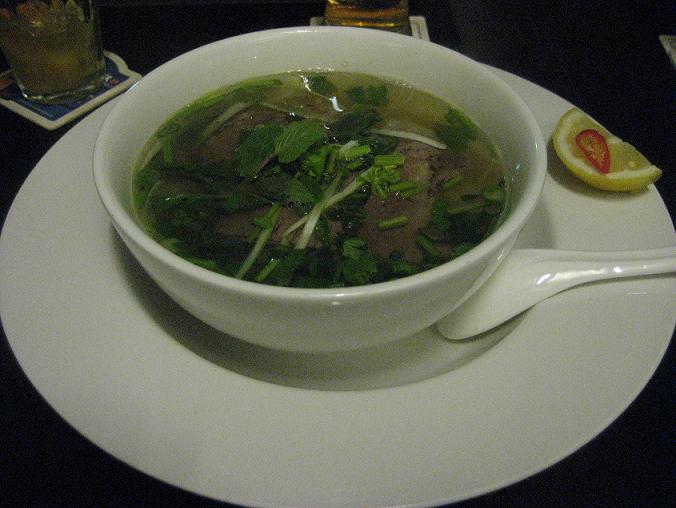
We then shrugged and hoped the main courses will improve our first impression. We ordered the Pho Bo (the clear soup you have to order at just about any Vietnamese restaurant, the bouillon can be either vegetarian, or as in most cases – based on chicken. This time it was beef for 6.90 €), Dau Phu Sate (a vegetarian dish with tofu and vegetables in sate sauce, 6.90 €) and the Ga Xoai (chicken skewers with sweet potatoes, vegetables and chunks of mango in mango sauce, 7.40 €). They came rather quickly and looked quite beautiful. The sauces all looked very appealing and the portions were not the smallest. Which was why we felt the bitter sting of betrayal when we had realised they all were all blessed with the same identical taste: blandness. Despite the different shapes and colours, these dishes had no taste whatsoever. The Pho’s broth tasted of the liquidy thing you get if you put Knorr’s mixture in a litre of water and stir. Even the 89 Cent ready-made glutamate-based Pho noodle soup from the Asian supermarket down the road is more inspiring than this soup (and I should know, this is exactly what I had to eat when I got back home.

Pho
Skewers in Mango

At the end of the day, Good Morning Vietnam is not BAD. It is just boring. I reckon bland food is better than bad food, but it doesn’t make it any more deserving of your hard-earned Euros. Go there in the summer for a cocktail in the inner courtyard if you want to appreciate its good sides. Otherwise, Berlin and Kreuzberg have more than enough Vietnamese options to choose from.

Overall mark:


Good Morning Vietnam
Bergmannstraße 102, 10961 Berlin
Tel: +49 (0)30 62 90 13 77


View Larger Map

February 10, 2011

Dancing on Tables? If You Say So

Ypsilon - Kleistpark, Schöneberg

When I was about six years old I asked my mother at some point why Greeks enjoyed breaking plates. “They don’t”, she answered with a grownup sigh. I sneered back and said I had seen them with my own eyes. And I was right. My easily impressionable nature was repeatedly traumatised by the loud gentlemen standing in front of Greek “tavernas” on touristy streets. All they seemed to be doing was to shout “ouzo” and throw an endless supply of plates with impressive force on the ground. For me it was clear there was something fishy about these Greeks and their strange affection to smashing objects. I could not fathom what on earth would cause a whole nation to live in a perpetual Birmingham-City-fan state of mind.

What I did not understand at the time was that some restaurant goers actually perceived this useless display of violence as exciting. And that was exactly what Greek restaurants in Northern Europe are all about: they sell an image of a land abundant in hot-blooded and colourful agitation that is so much more exotic than the drab gloom present in all of our everyday lives.

And then, when a friend asked me whether I wanted to try out Ypsilon on Hauptstraße (just off U-Kleistpark) because he had seen people dancing on tables there, my reaction was simply “I’m in as long as nobody’s going to break any plates”. Dancing on tables was exactly the right amount of excitement I could deal with: lively and utterly pointless. I could not quite call it exotic, as the only time I saw people dancing on tables had actually been actually in Warsaw.

Considering the fact I was lured all the way to Schöneberg under pretence of seeing people dancing on tables to the sound of a buzuki, the place was awfully quiet. Ypsilon has quite a large space and the overall design was rather tasteful compared to what Greek restaurants in Berlin usually deliver. No in-your-face bright lights, no pillars and no random Greek gods lurking around the place. This is not to say the place was entirely pleasing. The walls were too red and it felt like a mash-up of a cheap cocktail bar and a posh restaurant. A stage with a microphone was set in a central location, looming. A promise of live music and dancing on tables. It was still too early for that yet. We could concentrate on the food instead.

We started by ordering dolmades (stuffed vine-leaves, according to Chris the only true test of every Greek restaurant, 4.30 €), melitzana (mashed aubergines, 4.20 €), spanakopitakia (puff pastry filled with spinach, 6.30 €) and kalamarakia (pan fried calamari, 5.90 €). The starters came on large plates, decorated with fresh looking vegetables. They were also rather convincing on the quality end. The dolmades were not too sour and the rice filling was soft and nice. The aubergines were bland, as were the spanakopitakia, but they were not entirely bad. The calamari, however were even quite good. Not too rubbery and not too greasy. For pan fried calamari they were even rather pleasing.

The Wall
Starters

The main courses were a bit less convincing. We ordered a souvlaki arni (lamb skewer, 15.50 €) a bifteki gemisto (a piece of minced meat stuffed with feta, 10.90 €) and the moussakas (a dish not entirely unlike shepherd’s pie: a casserole based on layers of minced meat, aubergines, potatoes and cheese, 9.80 €). Generally speaking, the portions were very large and the presentation was appetising. The seasoning of all three dishes was also quite convincing. The only problem was the quality of the meat, which was lower than simply disappointing. It did not matter much in the case of the moussakas which is all about the sauce and the seasoning anyway. It had just the right consistency and the right touch of just about everything. It was no work of art, but it was thoroughly pleasing, even though a tad overpriced. The bifteki was fairly mediocre – with the meat not being exceptionally good, but it was still alright with the chips served on the side. The souvlaki turned out to be the main problem. When the entire point about a certain dish is eating chunks of meat off a skewer, you can’t really camouflage its poor quality with anything. Add the fact it was the most expensive dish on the menu and you’ve got stuff bad reviews are made of.

Moussakas
Souvlaki

As we turned to the perfectly friendly waiter and ordered the bill, we looked at the stage and the microphone one last time, feeling cheated and betrayed. The place had not become any more exciting or promiscuous, even though it was already long past 11. Without any dancing on tables to cloud my better judgement, I feel obliged to give Ypsilon three prints and feeling rather generous about it. It was not bad, but far from being good for the not-too-low pricing. Checking out their website I saw why we missed the action though: It says they have live music every Friday and Saturday after 11, but we went on a Sunday.

Overall mark: 


Ypsilon - Restaurant/Café/Bar/Sommergarten
Hauptstraße 163, 10827 Berlin
www.ypsilonberlin.de


View Larger Map

February 04, 2011

The Importance of Eating Kimchi

Madang - Korean Food

A few years ago I spent the evening sitting across the table from a South-Korean lady of sixty in a fairly nice Parisian restaurant. We were both waiting for my French aunt, who eventually showed up two hours later than planned. By that time we had been forced into making useless conversation about the weather, the restaurant and the French in general. The Korean lady was petite and fashionably dressed in white. She was wearing a white turban and was holding a white dog on her lap. Its white face had the shape of a white snail.

The one thing that kept the conversation going was our fantastic ability to whinge about nearly every possible subject: the sky, the noisy tourists at the other table or the low quality of French television. And yet, I thought she was taking it one step too far when she had started moaning about the bad food in France. I actually regarded food as the one advantage of living in France. When I finally asked what the problem was, her answer was just as cryptic: “No kimchi”.

“Kimchi?!” I thought. Yes, I knew kimchi and I had always liked it. But does lack of kimchi automatically disqualify any other cuisine? She nodded. “You’re not Korean,” she frowned, “you’ll never understand.” She then told me a story about how the Japanese uncovered North-Korean spies by serving large meals with a bit of kimchi in them. Most of the real Japanese around the table would sneer at the red stinky cabbage, while the North Korean spies – otherwise the perfect image of good Japanese men and women – would be the only ones who would devour it with unmistakable enthusiasm. “Alright, if you say so”, I shrugged.

After this conversation I also started developing kimchi-cravings. As I said, I had always liked Korean food, so it was not entirely new, but for some reason, it was only after the fashionable Korean lady’s stories that I started appreciating its due place in the pantheon of world cuisines. With time I learned that Korean restaurants were just about the best thing you could get. And for a long time, the lack of kimchi in Berlin stood as a symbol of the city’s culinary inferiority to food capitals like New York, London or even Glasgow and Stockholm. And then a few years ago something quite wonderful happened: Korean restaurants started appearing in Berlin. In order to start mapping Asia’s finest outposts in Berlin, we ventured out to Madang on Gneisenaustraße, just off Mehringdamm.

Tiny pancakes and noodles
Bibimbap

The inside is quite spacious and the ambience is a fairly pleasing middle ground between poshness and an Asian hole-in-the-wall that serves greasy noodles. The lights are a tad too bright and the chairs are a tad too reminiscent of furniture you got in the 80’s if you happened to step into any generic Chinese restaurant in the West Midlands. But then again, none of it is really disturbing. The waitress seemed to be overwhelmed by the job, but was otherwise professional, nice and helpful in a way you rarely get to behold in Berlin. The prices were all humane and the menu was large enough to be intriguing, yet not so vast it got confusing.

The first round was an array of starters, ordered both from the “appetizers” section as well as from the “sides” section. The waitress hinted the sides were just larger and better appetizers, and it turned out to be true. The Chljeonpan (tiny pancakes with five miniscule different vegetarian fillings and mustard sauce, 3.50 €) and the Chung mu Gimbab (three pieces of sushi-like rice rolls with a tiny portion of squids and radishes in spicy sauce, 2.90 €), both ordered from the “appetizers” section, were both nice, but too small and unspectacular to be really pleasing. The good thing to be said about them was that you got your money’s worth and the spicy radishes and squids were very good. However, the “sides” were a different story altogether. The Gogi Chanche (noodles made of sweet potatoes with vegetables and beef, 4.90 €) were very good and the Kimchijeon (pancakes with kimchi, 5.50 €) were nothing less than spectacular. They were soft and conveyed a myriad of different tastes. In fact, they were so good we found ourselves obliged to order another round of them.

The grill in all its glory
Ideally it would be eaten like that

For the mains we concentrated on two types of dishes: my beloved bibimbap (rice, vegetables, meat and egg all mixed inside a hot iron pan together with spicy sauce. I chose the “Imperial Bibimbap” or the Jeonju Bibimbap with beef and nine different types of vegetables for 9.50€. It is also available with tofu or with other types of meat and costs less. One can also get them in a boringly normal bowl without the heat factor for one Euro less. But what’s the point in ever doing that?) and the bulgogi (a grill dish in which you witness the meat grilled in front of your face and you can eat it together with various different sides. Madang offers a variety of grill platters for a minimum of two persons. Our table went for the Sabulgogi, or the beef grill for 13.50 € per person).

The portions were quite large in both cases. The main dishes came with fresh kimchi, marinated beans and marinated potatoes. Before I get to the description of the actual dishes, a word: the most important indicator for the quality of Korean food is the kimchi. And this one was perfect. The texture, the spiciness, the taste and that awful stench were all just right. The dishes were brilliant as well. I could have used a bit more spicy sauce for the bibimbap, but it was perfect otherwise: the size and the quality of all the ingredients were both just right, the pan was sizzling and it was highly enjoyable. The bulgogi was just as good. The cornerstone of a good bulgogi is the quality and taste of the meat. It scored well on both. High quality meat and fantastic seasoning. The meat came with rice and the aforementioned sides, while the whole lot was supposed to be stuffed into a leaf of lettuce. However, the meat itself was so good that we found ourselves eating it “freestyle” with the rice and the sides serving for pleasant distractions.

Bottom line: Go there. Good quality, good value. It doesn’t offer the posh experience other Korean restaurants do, but the quality of the food compensates for it. At the end of the day, very little compares to good kimchi.

Overall mark:


Madang
Gneisenaustr. 8, 10961 Berlin
Tel: +49 (0)30 488 27992


View Larger Map

January 30, 2011

Show Me Your Teeth? Tapas in Kreuzberg

Las Primas - Restaurant - Café -Bar

Let’s talk about teeth. Do you find them aesthetically pleasing? Mildly attractive? Sexually appealing? I remember meeting this girl at a house party in Paris aeons ago. She was petite and her hair stank of unrecognisable substances (or just weeks of unhygienic neglect. It was France at the end of the day). She told me she found teeth sexy and that mine were just perfect. I thought it was a dorky comment and it provided me with the excuse I so needed to get away from her and try to mingle with the beautiful people around. As the evening unfolded I found myself drinking seventeen glasses of cheap vodka and puking on a kitten. In retrospect, I probably should have continued talking about teeth.

But teeth. And sex. Doesn’t it ring a bell? Isn’t it what True Blood is all about? It depicts vampires as highly sexualised beings. Just like that girl’s hair reeked of not-taking-any-showers à la Française, they emanate sex. And they convey their sexuality through their fangs. I must admit that those fangs are quite perfect: they are perfectly white and symmetrical, appealing to every human’s sense of aesthetics. However, this is not the case with everyone’s set of teeth (or fangs, for that matter).

When I was little, my mother used to scare me with stories about people who ate too many sweets and got black teeth which eventually fell out. Her scare-tactics did not, by any means, help combat my obsessive sweet tooth, but they added yet another phobia into my interminable arsenal: the fear of people with black teeth. I find it difficult to look people with bad teeth in the eyes, because I know I will, at some point, avert my gaze onto their teeth with a convulsively disgusted expression on my end. This was my reaction the first time I found myself ordering an espresso at Las Primas on Wrangelstraße. It was about two years ago and I had gone there with a friend of mine on a perfect summer day. As the waitress smiled at us I could not help but notice one of her front teeth was made of gold while the rest were pitch black with completely rotten gums. I cringed and twitched and vowed never to come back.

This ridiculously long introduction brings us to this week’s events. It was one of these days when you feel like eating many small things rather than a real meal. It called for tapas and I had to meet friends later in Friedrichshain. The turn of events made it clear there was no way I could avoid checking out the tapas at Las Primas. I braced myself and prepared to meet that revolting set of teeth yet again.

Having only seen the place from the outside, I had expected the inside to be utterly filthy. I don’t know why, but it was just an illogical premonition, which fortunately proved to be wrong. The café/bar/restaurant is run down in a way that cries both “Kreuzberg” and “Spain” at the same time: dirty-pastel walls combined with tables crammed up together and covered by unappealing tablecloths. There is an evening menu with an appealing selection of main courses, but we decided to go for the tapas. I was delighted to see the choice of tapas was rather limited and the menu did not go on for eternities. There are about twelve dishes for the unit price of 4.00 € and six more for 5.00 €.

Tapas
Flan

We chose Pincho de Tortilla (a piece of tortilla, 4.00 €), Patatas al all-i-oli (fried potatoes in aioli sauce, 4.00 €), pintxo queso cabra (fried goat’s cheese with caramelised onions, 4.00 €), chorizo riojano (pieces of chorizo baked in white wine sauce, 4.00 €), pintxo de terena con reduccion de balsamico (slices of steak in balsamico sauce, 5.00 €) and gambas al ajillo (prawns in white wine sauce, 5.00 €). It was all quite endearing – small plates that were still large enough to get a good taste of the dish. The tortilla was unspectacularly nice, as tortillas are supposed to be like. The potatoes were nothing more than nice, but the aioli was fantastic. The cheese was very good quality and it came in a large portion with very good onions. The chorizo was also quite good quality, but the sauce was just alright. However, the two surprises were provided by the two 5.00 € dishes, with the meat being nothing less than excellent and the gambas turning out to be rather disappointing (the bland sauce killed them, which is quite annoying, as I find killing prawns to be a mortal sin). At the end of the day, most of the tapas were good,if not very good. The only real problem was the stale bread, which ruined the idea of truly enjoying the sauces. I then took a flan (the Spanish version for crème caramel, 2.70 €) to give the meal a good closure. It was alright, but not too convincing: Good size and perfect taste, but the texture (which is probably the most important part) was a bit scruffy.

Las Primas is a good choice of venue for good and hearty tapas. It is one of these places in Kreuzberg that manage to combine both roughness and pretentiousness, but it’s still pleasing enough as long as you avoid the waitress’s million pesos smile. I know it’s not politically correct to slag off people with bad dental hygiene, but I just can’t help it. Despite the bad teeth, the stale bread and the unconvincing flan, four prints seem like what the place deserves.

Overall mark: 

Las Primas
Wrangelstraße 54, 10997 Berlin (Kreuzberg)
Tel: +49 (0)30 60 03 11 32


View Larger Map

January 25, 2011

Food with a Moustache

Mimino - Georgisches Restaurant

Georgia (the country, not the state) has been an inseparable part of my world of references as far as I can remember. Even before I knew “Georgia” was a place, I knew “Georgian” was a perfectly acceptable adjective my Polish grandmother used in order to conjure the image of short, hairy and unhygienic men with thick, black and no less unhygienic moustaches. She could also use the word “Georgian” to describe my aunt’s obsessively tasteless collection of too colourful porcelain dolls. Sometimes she would say she’d just been to a “Georgian” restaurant, but by that she usually meant she had just been to a hole-in-the-wall that served greasy food and whose owner was a useless bum. Georgian food was something I only discovered later.

I cannot recall the first time I had Georgian food. I know I liked it and I know I could not help thinking of fat men reeking of cheap perfume and sweat. What I can clearly remember was the last time I went to a Georgian restaurant: it was a popular restaurant in Tallinn, hidden somewhere around the higher floors of a seedy Communist block. Inside it was decorated with the best overdose gold, red and bad taste paraphernalia could account for. Everyone seemed to be holding cigarettes in their hands and most men’s faces were hidden behind large moustaches. The icing on the cake was a short and husky woman with a microphone on an improvised stage in the centre of the room, titillating her bosom, singing the same Russian song in loops: ochen krasivaya zhenshina, a very beautiful woman. Oh, and yes, the food was delicious. Georgian food is just splendid: it is this fantastic fusion of Russian, Turkish and Persian food. It can be rich and tasty, both comfortably well-known and exotically intriguing.

When I was asked whether I wanted to go and try out Mimino in Charlottenburg, it did not take long for me to cancel other plans I may have had and storm out of my flat in the direction of the U7 towards the Old West. The place’s name is based on a classical Russian film about two (moustached) Georgian men, whose comic-like figures decorate the menu and the windows. Apparently, it’s a must-see comedy in the world of Russian film making. The restaurant itself is also a strange mixture of bad taste and attempted poshness. The walls are off-white and the tables are all set to raise expectations. However, TV screens are strewn around the place, showing mute football. As much as I was disappointed the place did not remind me of that Georgian place in Tallinn, all hope was not yet lost: the obligatory stage, microphone and playback cassette-recorder were all set in place and a small man was howling something that was supposed to be Frank Sinatra.

The menu was promising. It had a pleasing choice of fairly affordable Georgian dishes. As a starter (and I should probably state they were also listed as such), we ordered Chinkali (dumplings, the Georgian version of Russian pelmeni and Polish pierogi. The menu suggested them in three versions: with meat, potatoes and cheese. They were only available in the meaty and cheesy versions. We tried both, with cheese for the unit price of 0.90 € and meat for 0.80 € min. 5 units). For the main round, we ordered an array of things: Ostri (veal in spicy bell-pepper sauce, 9.50 €), Tschachochbili (chicken in tomato-coriander sauce, 8.50 €) and two chatschapourris (a sort of dough with cheese filling and topping, once with double cheese and one with garlic, 9.00 € and 10.00 €). As the main courses all come without sides, we ordered two more dishes of potatoes (3.00 €).

Ostri

It was then the chaos started. It seems like the division between “starters” and “main courses” was but a mere recommendation, as the first two dishes that appeared on the table were the first chatschapourri and the ostri. The ostri was not that spicy, but it was absolutely delicious. The meat was tender and the sauce was spectacularly good. The huge pot came without the potatoes or any other sides, and it took us a while before we realised we had to eat it before the other things came, or else it would get cold. The same goes for the chatschapourri. It was good, but a bit too monotonous and heavy: it was just dough with cheese, and lots of it. I’m the last one to say anything against dough and cheese, but it felt like eating a pizza-shaped brick. With those two dishes on the table, a waitress came out with a tray of butter cakes and asked us how many we wanted to reserve for the dessert, as “they are delicious and there might not be enough left once you get to the end”. We frowned, but could not take the pressure and reserved three.

Chatschapourri
Chinkali

Slowly but surely came out the other courses. The second chatschapourri seemed like an even heavier brick, but tschachochbili compensated for that by being delicious, yet still lacking its side dish. All the portions were very big, so that we were all more than satiated after the four main courses without the sides or the starters. This did not matter much for the waiters, as suddenly the chinkali decided to arrive. They were huge. Perversely so. The ones with the meat were utterly tasteless. The ones with the cheese (served with double cream and prune confiture) were fairly good quality, but so heavy they were difficult stuff down our throats. Just as the last bit had gone down, the waitress came out with our sides of potatoes. We managed to explain it was a bit too late for that, and after a bit more squabbling we even managed to cancel our pre-ordered dessert, as the last thing we were able to handle by that time was a butter cake with cream on top.

At the end of the day, it was quite an experience. The restaurant was chaotic and the service was miserable and pushy even for Berlin standards. But then again, it just made things strangely authentic. The food balanced between absolutely delicious (the meat dishes), good quality but too in-your-face heavy (the cheese dishes) and rather tasteless (the meat chinkali). A meal based on meaty main courses ONLY would probably be quite a success.

Overall mark:

Mimino - Georgisches Restaurant
Waitzstraße 1, 10629 Berlin
www.mimino-berlin.com 


View Larger Map

January 16, 2011

Berliner Spezial no. 1: The Best Bagel in Kreuzberg?

Mirror, Mirror on the Wall, Which Bagel is the most Brilliant of All? 

I greet thee to the first ever Berliner Spezial. And this time – bagels. I can already see those wrinkles on your foreheads, your curved eyebrows and that questioning look: why bagels? Aren’t Berliner-Spezials supposed to be about something representative of Berlin? What happened to Currywurst? Eisbein? Döner? Worry not! They will all receive their due place in the footprint annals of history. However, it somehow felt right to start with bagels. Let me explain...

It may be a fairly new thing, but bagels seem to have been adopted by Berliners. I believe it started with the Bagel Company. A few years ago it was still nearly impossible to get bagels in most places. Cafés in Berlin were mostly about coffee, cake and breakfast, with the odd sandwich out every now and again. And then, just about the same time as the hipsters had invaded Neukölln and Berlin had become a European Tourist Mecca, a wave of bagels suddenly came upon us.

I like bagels. I also like that international flair they convey: at the end of the day they are the culinary outcome of what the academia would define as “trans-national border crossing”. Poor Jews had left their home countries and came over to seek a better future in the New World, just to turn bagels – as they eventually turned themselves – into an essential and innate symbol of the worldliest of world cities: New York. Bagels to New York are like the Big Ben to London. Any city wanting to stand in New York’s worldly limelight needs its own local bagel culture. And this is where Berlin enters the picture, with bagels becoming ever more present in the city’s café culture.

The last week was spent in the company of bagels from five different cafés in Kreuzberg and Neukölln. Those cafés were marked and ranked according to four criteria: Variety, bagel quality, quality of the filling and ambience (an inevitable factor, as we are talking about cafés. Nevertheless, I tried to avoid including the quality of coffee or cake into the picture. There will be other posts for that). Feel free to comment on the results:

Overall rank no. 5: Cuccuma, Zossener Str. 34, 10961 Berlin
www.cuccuma.de

Price: 2.50 €

Variety: 5th. A very small and unspectacular variety. Mostly lox, salami and Gouda. The bagels stand in the display case ready with the filling. Visual selection is easier than choosing from the menu, yet it still makes me think it’s less fresh and it gives me the creeps because I don’t know how many hands have already touched it.

Bagel quality: 2nd. Yes. The bagel itself is fantastic. Doughy, tasty and light. Highly good quality.

Filling quality: 4th. The filling itself is alright, even though it’s fairly unspectacular: it tastes fresh (even though the fact it’s been standing outside in the display case might awaken other instincts) and the quality is alright. It’s even healthy, with two slices of tomato and salad. Quite good, really.

Ambience: 5th and my real beef with the place. It is the most Starbucksy of the lot, trying to be a real iBook-café, but without the space needed for a comfortably professional atmosphere. As it is, it just reminds me of what I dislike about Manhattan: Not enough space, too quick and too plastic-fantastic. Americans in need of a less “European” vibe might appreciate it, I just thing it’s useless.

Lox bagel
Cuccuma

Final remark: Not a bad bagel, really. It’s a shame the variety and the ambience couldn’t be more convincing.


View Larger Map

Overall rank no. 4: Ringo, Sanderstraße 2, 12047 Berlin
Price: 3.50 €

Variety: 4th: You can choose between three types of filling and cross it with three types of bagels. I’m not impressed by gouda and ham fillings, but you can’t blame them for being basic.

Bagel quality: 5th: I’m sure it was a frozen bagel from Kaiser’s or even worse – Lidl? It was warm, which was nice, but it still tasted of what ready made bread from the freezer tastes like after a good toasting. It was fluffy without being good. I don’t mind fluff when it comes to English white bread, but bagels? No.

Filling: 5th: It was very generous and just right, really: the cream cheese, the lox, the rocket leaves, everything smudged together was basically right. But it wasn’t fresh. Not at all.

Ambience: 1st: Which brings me to why Ringo was such a bagel disappointment in the first place: It’s a really nice café! It’s one of those “wannabe Brooklyn cafés”, yet it is so much better than anything you’d ever find in Williamsburg. It’s got the space, the cake and the prices only Berlin can offer with a touch of inclusive “coolness”: even though it’s a hipster café, you won’t feel bad about yourself sitting there not being one.

Lox and cream cheese
Ringo

Final remark: Brilliant café, just don’t go there for the bagel!


View Larger Map

Overall rank no. 3: Goldmarie, Grimmstraße 29, 10967 Berlin
Price: 3.20 – 3.70 €

Variety: 3rd: A few more options on the menu than the former two. Officially, you can’t choose the bagels to go with the fillings, but you could if you asked the waitresses.

Bagel quality: 4th: What can I say? Not very good. Really, why do you offer bagels if you can’t find a good bakery to produce them? It was small and didn’t taste of much.

Filling: 3rd: Oh joy. It was great. Quality and quantity all combined. Heaps of vegetables and healthy stuff, carrot and cucumbers cut into small shapes and forms just to give you the impression of being king. Yay. The only problem was that it was difficult to discern one main taste to give the whole filling a bit more character. But still – go for it.

Ambience: 2nd: It’s a really nice café. Just by the canal, comfortable seats, pleasant service. An address to remember (and I am biased by their cake. I know, I said I wouldn’t mention it, but come on, like, rhubarb or gooseberry cake? How can anyone resist THAT?).

Lox and cream cheese
Goldmarie

Final remark: Nice café, good bagel presentation, with the filling compensating for the poor bagel quality. It gets even nicer in summer, though.


View Larger Map

Overall rank no. 2: Wilhelmine, Gneisenaustr. 67, 10961 Berlin
www.cafewilhelmine.de
Price: 2.80 – 4.00 €

Variety: 2nd: The menu didn’t have more options than Goldmarie’s, but they were a lot more exciting. Not only the usual sesame bagels with lox and cream cheese, but also a za’atar bagel (za’atar is a Lebanese/ Middle Eastern mixture of spices and herbs). Quoting Glee’s Kurt: Vive la difference!

Bagel quality: 2nd: Just about together with Cuccuma, really good bagels. The overall quality of the bagel might have been a bit inferior to Cuccuma’s, but then again, together with the za’atar it was quite fantastic. And anyhow: just right, doughy and joyous.

Filling quality: 2nd: The bagel came out with fewer slices of carrots and cucumbers to decorate the endeavour, but it was generous with the right things. It provided the bagel with a strong, distinct taste of what you had ordered. Very good quality.

Ambience: 4th: I really like Wilhelmine, but mainly because of the friendly service and the fact it’s so close to home. Otherwise, its design and choice of furniture, lights and atmosphere are far from perfect. It’s all very functional and comfortable, but can seem a bit sterile at times.

Za'atar, goat cheese, sun dried tomatos
Wilhelmine

Final remark: The perfect place to take your parents for a bagel. Cosy and suitable for dark wintry days, it’s a pleasant café with good quality bagels.


View Larger Map

Overall rank: 1: A’horn - Café und Fahrradladen, Carl-Herz-Ufer 9, 10961 Berlin
Price: 3.80 €

Variety: 1st: A list of eight types of homemade bagels to be selected with eight possible types of fillings. No traditional lox bagel, but then again, the world has more to offer than just smoked salmon.

Bagel quality: 1st: What can I say? Absolutely delicious. Perfect quality with the increased joy of choosing between things like olive or tomato bagels. They have the perfect texture and taste. I wouldn’t mind them being bigger though.

Filling: 1st: Again. Very good. Generous amount of high quality filling together with just enough vegetables and pesto to make it all taste as it should. And it even gave me the satisfaction of eating something healthy looking.

Ambience: 3rd: The A’horn is a new place, opened just on the corner of Baerwaldstraße and the canal, which used to be quite a dead and drab corner. Livening up the area is a blessed idea and the design is nice. It’s a perfect café if you want to get some work done: it’s quiet, spacious and you won’t get disturbed. One downside: I had to wait for a LONG time before getting served. Take it into account.

Olive bagel with goat cheese
A'horn

Final remark: Probably the best bagels I’ve had in Kreuzberg so far, all packed in a pleasant atmosphere. Go there for the bagel or if you’re around the block (because there aren’t any other real options to begin with), but if you are looking for the perfect café, there are better places on this list.


View Larger Map

And a few general remarks about bagels:

1. Size does matter. I couldn’t help thinking how much I missed those bulky bagels from America. You know? The ones you can’t just fit into your mouth. They might be over the top, but they reflect the true essence of bagels: being as large as they are, they’re all about the dough. I believe this is the reason even my Brooklynite family’s embarrassingly horrid taste in food was not able not ruin a bagel. Even though they managed to wham every possible culinary (kosher) atrocity on their table (which was, same as the rest of the furniture, covered by a plastic foil), turning dinner into the most painful experience I have ever endured, the bagels still remained an island of edibility: my own private survival cord through painful Shabbat dinners.

2. Bagels are not necessarily the “healthy American option”, which they seem to be hailed as around these parts. Big, chunky and fat bagels are not any worse than healthy ones. It also means the filling should be treated accordingly. I definitely enjoyed receiving bagels I could eat without worrying their grease would kill me within the next couple of hours, but I did wish I could choose options like “eggs and cheese”. Personally, I would be in favour of starting a petition to introduce bagels with scrambled eggs into the local variety. Who’s with me?