June 03, 2011

Knowing Nina (Greek Galore)

Ousies - Schöneberg

Studying in Paris, I got acquainted with a number of characters I would not have met otherwise. Amongst them was a young man who always scribbled down the word “Prince” under the field “profession”, a girl who often arrived in tears because her parents would not allow her to employ more than three cleaning ladies for her 700 square meter flat (which they had maliciously bought for her in a posh suburb rather than in the city centre) and then there was Nina.

She was a mousy girl; quiet, timid and fairly introvert. Being Greek, she spoke French with an accent most of our fellow students frowned at. It was not entirely simple to become friends with her, yet I liked her and we got along very well from the very beginning. It did not take a genius to realise we had grown up in different circumstances and with different values. We were interested in different things and reacted differently to just about every possible situation. And yet we did not enquire too much into each other’s backgrounds. Knowing she had come from a very sheltered home was more than enough.

I learned more about her on a spring day after an excruciating set of exams and presentations. We needed a walk in the polluted Parisian air to get over the day’s traumatising start and we began by wandering aimlessly between some of Paris’s most expensive shopping streets. On more than one occasion, Nina would see a shoe she fancied in one of the shop windows and without blinking would then step decisively into the shop and come out two minutes later with a completed transaction and a colourful bag in her hands. I did not ask how she was able to afford any of it, as my mother had told me it was not polite to talk about money. Every now and again, however, Nina would murmur an undecipherable sentence about her father needing to wire her shoe money.

As the day came to a close and we were both getting hungry, Nina suggested food and asked me whether I knew a nice place. I proposed an Indian restaurant I knew behind Gare du Nord and we began making our way northwards in silence, which was not our usual state. A few minutes later it was Nina who broke it by saying she had never before been anywhere around Gare du Nord and that she was afraid. “Is it dangerous? Are there any... you know... strange people over there?”
“It’s alright,” I shrugged. “I’ve never had any problems over there.”
“Oh, OK,” replied Nina, not too sure about whether to trust me or not. “But I heard there were Arabs up there.”
I shrugged again. I did not like these conversations and could do without another one of her lectures about why Greeks felt unsure around Muslims and why I should not put her in danger. We had already had that same conversation a few times before. The girl should grow up, I thought. My sense of conviction did not seem to put her at any ease though. A few minutes later she asked whether Indian food was hygienic.
“You see,” she began, “I’ve never had any of it before.”
“Oh... it’s fine. It will be an experience.” Which it was. Upon entering the place Nina wanted to turn on her heel and run away as fast and as far away as possible. Her eyes balls seemed to want to pop out of their holes and every little muscle on her body twitched in utter panic. I made her stay though, as she kept staring at the mainly Indian crowd sitting around us.

But she liked the food. She kept on nodding in pure amazement, whispering she would never have imagined she could like it.
“You see,” she said, “I’ve never liked anything besides Greek food.” It was my turn to stare at her in pure amazement. Thinking she had lived in Paris for such a long time and that she had been able to afford buying pairs of shoes for a few thousands of Euros in one afternoon, it did not strike me finding good food in Paris would be all too difficult.
And yet, to her it was. It turned out she was a billionaire’s daughter. She had lived in a sheltered Greek paradise with access to every shoe brand on the face of the planet, but food diversity had never been all too high on her shopping list. To be fair, she did not enjoy discovering new food stuff. She just liked the homey feeling Greek food gave her.

After this evening, as more and more of our conversations turned to the subject of food, Nina would spend more and more time describing the wonders of the Greek cuisine. I was not always convinced, but these long stories about the abundance of meat served in a friendly atmosphere she obviously missed in Paris made me think of Greek food as a potentially utopian thing. As I later realised most Greek restaurants in the countries I lived in were of the greasy-and-bland type, I started recalling Nina’s descriptions ever more often as an alternative for the actual unspectacular quality I was otherwise confronted with.

And then last week, I was time to try out a new restaurant with a friend from Paris which somehow evoked the memory of Nina. The bizarre association called for trying out a Greek restaurant and we opted for Ousies on Grunewaldstraße in Schönberg, having heard it was a lot better than the average Greek experience in Berlin (little birds usually whisper in a cacophony, the place is always crowded. Reservation recommended).

We sat outside, which was nice in itself, but even if we had decided to sit inside, it would not have been any worse, as the usual columns and Zeus figurines are pleasingly absent from the large indoor space. Instead, the restaurant looks like a scene from a retro film about 1960’s Italy with pink walls, light tables and endearingly overused tablecloths.

Starters
Beans and sausage

The two of us were soon overwhelmed by a menu long enough to keep an army eating for a good week. Moreover, it was more expensive than most Greek restaurants in Berlin. This called for a clear strategy and we decided to order a number of “representative” dishes. The starters we opted for were the eleosalata (slices of tomatoes covered with olive paste and a slice of goat’s cheese, 5.00 €), dolmadakia (those stuffed vine leaves, served warm for 7.30 €) and gigantes me loukaniko (large white beans in tomato sauce with slices of Greek sausage, 6.50 €). All were very good quality. The vegetarian starter was fresh, the dolmas had the right consistency and a very distinct taste and the beans were just beans with very good chunks of sausage. And yet, it felt like paying a lot of money for what was – at the end of the day – just very simple food.

The main courses went along the same line. We ordered mousakas (a dish based on layers of minced meat, potatoes and aubergines, 13 €) and a bifteki gemisto (a minced steak with a cheese-pepper-tomato filling served with a side of potatoes, 12 €). The mousakas was very authentic – it was a simple, hearty dish with the right seasoning and the right amount of grease. The bifteki was too heavy to be pleasing, but the meat was well seasoned. The side of potatoes was utterly dry and not very appealing.

Mousakas
Bifteki gemisto

We left with bloated bellies and mixed feelings. Generally speaking, the food quality was pretty impressive compared to every other Greek restaurant I’ve been to in Berlin. And yet, the otherwise well known Berliner pattern of excellent starters and less inspiring main courses repeated itself even here. Moreover, even though the quality was definitely a bit better than anywhere else, the prices were also a lot higher, which was not necessarily justified by the fact that the food was not yet “amazing” or “inspiring”. If you are like Nina and crave Greek food in big portions – Ousies is probably one of the best choices around. If not, there are other things to get through an evening.

Overall mark:

Restaurant Ousies
Grunewaldstraße 16, 10823 Berlin
www.taverna-ousies.de
Tel: +49 (0)30 216 7959


View Larger Map

May 24, 2011

A Spring Diatribe

 Jäger und Sammler - Schöneberg

Veronika, der Lenz ist da“ is probably the most accurate representation of Berlin’s quirkier side to this date. It became a hit in 1930 when the Comedian Harmonists, the first ever German boy-band (who had to flee the country for the bonus of being Jewish) started performing it: A spring serenade to a certain Viktoria about phallic asparagus growing in pre-war Berlin. Oh, springtime!

To be fair, the world that produced the Comedian Harmonists is long gone. Viktoria is probably dead, as are most of Berlin’s Jews together its pre-war flair. What’s left is that pure joy and excitement that never fail to arrive alongside the first day of spring, when everyone suddenly becomes nice, accommodating and flirtatious. The sour faced cashier at the supermarket who had grunted resentfully at the very sight of a customer just a day earlier suddenly winks suggestively as she licks her upper, voluptuous lip and asks the first male customer she spots whether he’d already seen their fresh Spargel. Spargel? Really? Now, that’s another example for the Comedian Harmonists’ legacy.


Spargel, or white asparagus, is the local spring obsession. During the asparagus season, every place in town - including Chinese, Indian and Mexican restaurants - will offer a bland asparagus menu for double its weight in gold. Inquisitive TV shows will screen special reports about this year’s Spargel-consumption and greedy farmers will erect half legal stands selling organic Spargel to those who can afford it. If it weren’t for the fact I found white asparagus completely useless, I would find it all quite amusing.

I grew up knowing that green asparagus was a delicacy, whereas white asparagus was used to feed the hogs. And I fully agree. White asparagus’s phallic form might be appealing to some, but it still has the consistency of sperm, being rubbery, stringy and mushy all at the same time. Before this diatribe takes me to places we all should avoid, I really should say I don’t mind white asparagus. I just do not see the point of serving it absolutely EVERYWHERE. What I find even more baffling is the fact people here actually eat Spargel as a main course with only potatoes as a side. To each his own, but I find that particular combination a tad too much.

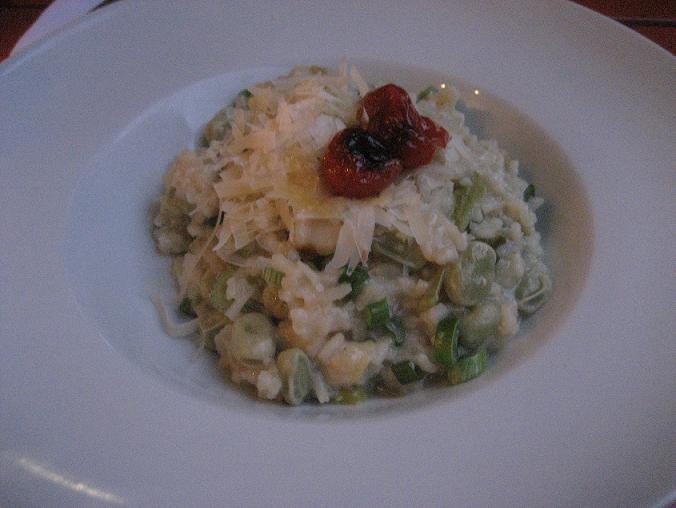
And thus I was looking for a spring feeling without too much Spargel and decided to go and try out Jäger and Sammler (Hunters and Gatherers) in Schöneberg. It was one of the first sitting-outside-evenings of the year, and we decided to make the most out of it despite the fact that the interior was remarkably attractive. We soon discovered the place had a very limited seasonal menu, which suited us just fine. The only problem was that the only starter was a (Spargel) soup on a warm day, so we decided to just share the “spring risotto” to kick start the evening (risotto with beans, asparagus and spring onions, 10 €). And what can I say? The dish was perfect. Risotto is a tricky one. Especially in Berlin it can be either extremely bad or perfectly endearing with very few middle-ground compromises. This one managed to get everything just right with a perfect texture and a pleasingly light taste.

Risotto
Flounder
We continued to the main dishes, which were the Finkenwerder Mai-Scholle (a dish of fried flounder with bacon and a side of potatoes, 14 €) and Rinderschmorbraten (beef roast in a vinegar-cream sauce with a side of mash, 14 €). Both main courses were quite alright, but not inspirational. The fish was impressively large, nicely fried with greasy bacon, which made it quite pleasing in a piggy sort of a way. However, it was too greasy to be refined and the bacon tended to outshine the fish, which was, unfortunately, not the main idea when we had ordered a fish. The meat was good. It was tender, high quality and the sauce was also nice. If it had been a bit cheaper, the first course a bit less impressive and the restaurant a bit less fancy, I would have approved whole-heartedly. But it was not cheaper, the first course had set the bar fairly high and beautifully decorated restaurants raise expectations as well. Tough luck.

Roast
Panna cotta

Even though these main courses were more than filling, I am glad I was smart enough (not to mention obliged by the blog) to order a dessert. The only sweet treat on the menu was a panna-cotta (served with strawberry sauce for 5 €), which turned out to be a dream come true. For some unknown reason, panna cottas tend to be fairly unimpressive. People who don’t know how to cook think vanilla creams are always an easy option and usually get it wrong (or bland, which is even worse). But Jäger and Sammler was one big exception to the local rule. It managed to get everything right: the cream, the texture, the strawberry sauce and the visual presentation. It was a fantastic way to end a meal.

At the end of the day, Jäger und Sammler is a good address. It is a sterling example of how some restaurants manage to raise expectations before getting to the main course, just to create disappointments with food that is fairly good, but just not enough to rise to the challenge of perfect ambiance, ambitious menu and wonderful starters and desserts. And yet, don’t let it scare you off. It is a perfect four-printer.

Overall mark: 

 
Jäger und Sammler
Grunewaldstraße 81, 10823 Berlin
www.jaegerundsammler-berlin.de


View Larger Map

May 09, 2011

Discovering Mitte

Chén Ché - Mitte

Could you believe I once lived in Mitte? It was over six years ago. Just around the corner from Rosenthaler Platz. Quite a few of the buildings over there had not been renovated yet and I enjoyed the romantic decrepit atmosphere. The flat was adorned with a couple of canon walls from the war, one of which forming a large crater between my room and the bathroom. Yes, it was a dump, but an exciting one of that.

Things happened in Mitte at the time. And by “things” I don’t mean a group of drunken Brits riding on a pedal powered beer bike screaming “blobby-blobby-blobby” or a bunch of Spaniards nonchalantly vomiting with a grin in front of their hostel while mumbling “Berlin, so alternative!” At the time it felt like real people lived in Mitte. Today, I am aware of the fact that some of them still exist, but I don’t know any of them anymore.

Do not get me wrong, I am not lamenting what’s happened over the years to Mitte. I whinge because that is what I do, but the tourist locust infesting Berlin’s geographic centre is not entirely negative. One big difference from the Mitte of yore is that fact things have become more international, worldlier. Six years ago - at a time when everything was still authentic – Berlin also felt more provincial. So it was time to go back to Mitte. To try and follow the zeitgeist and feel cool.


The Vietnamese tea house ChénChè (one of three partnered restaurants in Mitte) felt like the perfect choice for a zeitgeisty venue with its impressive homepage. Otherwise, its choice of location inside an inner courtyard on Rosenthaler Straße could not have proved to be any better. An inner courtyard is both intimate and secretive. Makes you think you’re special. The decor also deserves acclaim. It succeeds in combining the generically horrid Vietnamese/Japanese grand scale restaurant pomp with a touch of good taste and pleasing design. The lightning could use a bit of dimming on the edges, but otherwise it was surprisingly nice. My only disappointment was that the weather did not allow us to sit in the garden, which looked quite charming.

The menu is not overwhelmingly large, which was quite an advantage. Another thing I found quite sweet was the fact that most dishes were presented as vegetarian by default, yet possibly served with meat. From the list of eight possible starters we ordered three: Xôi Gà (sticky coconut rice, shallots, lotus root and chicken breast for 6.20 €), Hoành Thành (baked won-tons which we ordered with spicy tofu filling, 5.80 €) and Cha Giò (baked Vietnamese spring rolls with coriander dressing, ordered with pork filling, 5.80 €). The spring rolls were the only thing that was just alright. Their taste was nice, yet uninspiring and the coriander dip was too lemony to taste of anything else. Yet the other starters were just splendid. The won-tons were strangely crispy with filling that tasted of joy and the Xôi Gà was just perfect. Each of its ingredients had kept a distinct taste that created quite a splendid mix when randomly scooped out together.

Starters
Bùn Riêu

We then continued to the main courses. There are three main courses in the usual menu and three other changing dishes. We went for the Bùn Riêu (vegetable soup with tofu dumplings and rice noodles, 9.40€) and the Reistafel menu (a changing selection of dishes for 8.40 €). The soup was quite good. It was mildly spicy and was nice to eat, but it had a heaviness that felt nearly Central European. The Reistafel came with a number of various elements. It had a small bowl of Phó (Vietnamese chicken broth), which was hearty and good, but again, was so stodgy it reminded me of my grandmother’s Polish cooking. A chicken leg fried in pleasing sweet sauce greeted me from the bamboo hamper, and another dish of chicken in mild and tasty red curry was served in a plate on the other side. And then the obligatory rice and various vegetables. It was all fairly good. Nothing was too inspiring, but it was definitely pleasing. We ended the meal with a surprisingly and quirkily tasty Ché Choi Nuoc (rice balls filled with peanuts and chocolate swimming in coconut-mango sauce, 5.60 €). I usually don’t enjoy Vietnamese desserts too much, but this one was worth every Cent.

Restafel
Dessert
What can I say? The place was worth the trip to Mitte. Not only was it good, but it also provided us with some of the added values of going to the “centre”: It was the posh version of the sort of Vietnamese places you’d find in Kreuzberg. It was slightly pricier, but the difference was justified by a nice ambiance and good quality (which was exceptional in the cases of the starters and the dessert).

Overall mark:

Chen Che - Teehaus
Rosenthaler Straße 13, 10119 Berlin
http://www.chenche-berlin.de


View Larger Map

April 16, 2011

The Last Supper

L’Assaggino - Kreuzberg

My visit to Milan a couple of weeks ago was culinarily pleasing, but left me at a touristy loss. After the obligatory five minutes at the Duomo followed by a stroll through the Vittorio-Emmanuelle Gallery and a futile attempt to get into La Scala for less than 200€, I realised there were very few attractions left to be seen. Not that it bothered me too much, there was enough to keep me busy: from sampling pleasant cafés and restaurants through discovering lively areas to spotting fashion victims on the street, it was all there.

The one thing I managed to miss was the Last Supper. Exactly, Leo’s Last Supper, for a glimpse of which you have to register about three months in advance, or so it appears. As that weekend was supposed to be spontaneous, planning ahead was not a part of the shopping list. We followed a stream of busses loaded with Japanese tourists to the Corso Magenta to try the “We’ve come such a long way, you wouldn’t happen to be able to let us in? There must be a couple of cancellations” approach. Unfortunately, those Italians were already one step ahead of us, with a “TODAY NO CANCELLATIONS” sign looming just across the entrance. And sod off to you too, thank you very much. I left Santa Maria delle Grazie baffled: since when is not cutting corners an option in Italy?

With the bitter recollection of failure still etched into my membranes, I could not help drawing the parallels when I came to plan my very own Last Supper. It was a day before a tonsillectomy, which I knew would mean no real food for the foreseeable future, so it needed to be good. On the other hand, as I could not be bothered travelling far out of my comfort zone, it needed to be close. As I was already into digging up old Milan analogies for this supper, I thought L’assaggino just across the street would be a good way to get some Italian closure before entering a period of painful culinary deprivation.


L’assagino on Gneisenaustraße is one of these fairly new pastel venues on the Südstern end that were all opened around the same time. As pastel should be left in Prenzlauer Berg where it belongs, I have never experienced the urge to try out any of them. In addition, L’assaggino looked like one of these places that are not able to decide whether they were a shop or a restaurant: It had this strange balance between shelves and tables, which I just did not find to be too convincing from the outside (combined with the fact it always seems to be empty). The epiphany came when I read its opening hours and realised that a place that started doing business at 5 PM was rarely there to get you to buy produce that you’d still need to cook later.


As we had taken our seat and began scrutinising at the menu, I slowly started thinking this place might just be the perfect Italian: it was small, cosily inviting and exuded the family business vibe you expect small Italian restaurants to have. L’assaggino’s menu changes daily. It is fairly limited, with pricey antipasti, medium-priced primi and two desserts (yes, I know I was supposed to write “dolci” in there). As I was getting ready for surgery, I had to pass on the wine despite the wine menu’s promising contents. We started by sharing the Antipasto “fantasia” (for two, 15.50 €), which came promptly. It was fine, really. The dish was composed of a nice variety of sausages, cheese and the usual fried vegetables, all very fresh and nicely done. The portion was not huge, but the quality was good. I found that pricing it on 15.50 € was stretching it a bit, but that is just my notion. It was good, just not exhilaratingly so. The only thing about it which really was fantastic was the bread that came along with it.

Gnocchi
Tagliatelle

We continued with the two most expensive dishes on the menu, the tagliatelle neri “satore di mare” (black tagliatelle with mussels, shrimps and calamari, 12.50 €) and polenta gnocchi with beef ragout (polenta gnocchi being fairly large and dumpling-like beings, 12.50 € as well). My first reaction to seeing the dishes was a sneer of disappointment, as again, the portions were not very large. Living in Berlin you forget people elsewhere appreciate smaller, yet refined dishes. That notion faded into this air once I had taken my first bite. Both were nothing less than fantastic. The tagliatelle were the perfect pasta dish: the pasta (clearly homemade) was savoury, the spicy touch of the sauce was inspiring and the seafood was done just right. It was overwhelmingly tasty. The gnocchi were not any less impressive. Their form reminded me more of some strange cross breed between Italian gnocchi and Germn Klöße and they tasted accordingly: they were large and doughy and still astonishingly pleasing. The sauce was just perfect. It reminded me of a bourguignon rather than of a pasta sauce, but it was brilliant nonetheless, so who am I to pass judgement.

Crème brulée
Mousse

Even though we hadn’t planned on doing so, we ended up ordering both desserts on the menu: white chocolate mousse with red berry sauce (for the mere price of 5.00 €) and a crème brulée (served with caramelised figs for 4.50 €). What can I say? Pure joy served on a plate. The crème brulée had a citrusy taste to it, a perfect texture and the best caramelised figs one could ask for. The mousse was great as well, it had the perfect balance between lightness (texture + not too sweet) and taste. The sauce was… well… you can’t get berries wrong.

Not much to add as far as the bottom line goes. L’assaggino is quite a gem. It is not necessarily the place to go to with friends in order to bond over pint-induced burps and with the size of the portions, I needed a whole menu to leave feeling satiated, but don’t miss it if you are planning on spending a quiet evening with marvellous food and good company.

Overall Mark:


L'assaggino - Italienische Küche, Enoteca & Café
Gneisenaustraße 61, 10961 Berlin
www.lassaggino.de


View Larger Map

April 06, 2011

Jesus Loves Kimchi

Ixthys - Schöneberg

Let’s talk about the concept of a hole-in-the-wall: shops of miniscule proportions that often combine a run-down urban charm with industrously independent character. To put it more bluntly: they are family run dumps. Some people love them; others would never set foot past their mangy thresholds.

My father is a sterling example of a holes-in-the-wall-enthusiast. You can’t really blame him for it either. There is something authentically appealling about these urban grottos. Eating in a hole-in-the-wall, you realise you are in it for the food. Most people will not be there for the superb ambience generated by the fat stains, the old cutlery or the lack of space (my father might, but I hope you will allow me to politely sneer at the idea). With a hole-in-the-wall, you get the feeling you know where the food comes from – if only because you can see the kitchen behind the counter with your own eyes. And then, you know who does the cooking, sometimes you can even talk to them. It is small enough to see past the “business” character and be admitted into a family. Take a closer look and you’ll see it is a bit like paying a random grandmother to cook for you, and just like with your own grandmother, you’ll get the food directly from that battered aluminium pan into an old plate adorned by a decade-old scratch on the side.

Holes-in-the-wall can be either extremely good or extremely bad, and it is impossible to know which one it will be in advance. And then, the really good ones have a psychologial added value. Having a truly delicious meal in a grotto equals a major discovery. It makes you feel like a 2011 urban version of Christopher Columbus, sailing in the dagerous waters of a big city (because let’s face it: holes-in-the-wall are an inherently urban phenomenon), trying to immerse yourself in the local structure and culture, unlike all those lard assed tourists who just go to Starbucks’ because they know what they’ll get over there.

Berlin has less holes-in-the-wall than cities like New York or London because – let’s face it – there is no need for any. The spaces here are usually large and often affordable. Squeezing a restaurant into a lightless cell of 100 square feet is entirely unnecessary. Which was why I had to raise an eyebrow when I had walked into Ixthys, a Korean place in Schöneberg. Alright, I did not only raise an eyebrow, I was overwhelmed and did not know whether to laugh, cry or run for my life. The place was not only a classical hole-in-the-wall, but it was a missionary one at that. Ixthys is not a word in Korean, but rather the Greek name for “fish” and an early Christian symbol. The walls are completely covered with old and dirty canvases crammed with handwritten psalms and biblical texts. The small space is not unpleasant, but for a non-believer such as myself, it was nothing less than frightening (with a pinch of exotism).

The menu did not provide much relief either. The textual treasures hidden under the layers of grease referred more often to Jesus than to food. The last page was a highlight of sorts, as it started out explaining kimchi’s merits, describing to what extent the Korean cabbage dish can improve one’s health, just to recap and decide that end the end of the day, the “richest ingredient in life” was really just the love of the Lord. Yeah, right. The added value of the Christian faith was soon forgotten, as we finally found the food references. It did not take long to realise that the choice of dishes was astonishingly promising despite its being very limited. The menu was comprised of about five vegetarian and five meat dishes, and they all sounded good.

The walls...
Bulgoggi
We then ordered the Za-Chang-Myun (a noodle dish with bean sauce, pork and various vegetables, 7.50 €), the Doesi Bul-Go-Gi (pork and onions in a spicy sauce, 7.00 €) and the Bibim-Bab (a “mix it yourself” dish with beef, rice, vegetables and a fried egg, all the joy in the world for 7.50 €). The dishes came with a side of kimchi, which was very convincing (yet not as good as the one at Madang). It would probably be best to start describing the Bul-Go-Gi, which was tasty, but not too inspiring. The meat was nice, the sauce was extremely pleasing, but nothing more, really. The noodle dish was definitely a couple of notches superior. Not only was the noodle-quality superb, but the sauce was just brilliant. It was refined and exciting at the same time, with random slices of meat and vegetables to chew on (which were fine, but still secondary to that fantastic bean sauce).

Noodles
Delicious bibimbab

And then came the bibimbab. Alright, I might be biased. I believe bibimbab is one of the things Adam and Eve managed to smuggle out of the Garden of Eden and then went on to hide somewhere in Korea so that God wouldn’t find it and punish them. I think Bibimbab is pure joy and good bibimbab is a virtue. And this one was definitely good. Everything in it was just right: the meat, the vegetables, the quantity and the spicy sauce (which was served in a large, filthy jar, which was so much more pleasing than the embarrassingly small quantity seen elsewhere around here).

Needless to say, we did not stay too long. I did not mind the Christian theme as much as I was bothered by the uncomfortable chairs and the lack of basic facilities (yes, I mean the loo. For a place that offers tea on its menu, not having any toilets can be equated with crime). After a while we just had to go. And yet, I can only recommend Ixthys warmly. As far as holes-in-the-wall go, this one was just perfect, with the best possible value: good quality food for affordable prices.

Overall mark: 

Ixthys
Pallasstraße 21, 10781 Berlin
Tel: +49 (0)30 814 747 69


View Larger Map

March 31, 2011

Yes Girl, Carbs Are Good for You

Spätzle und Knödel - Friedrichshain

Even though ranting about all that is wrong with Germany has by now become my second favourite pastime (the first one being cake), I still have moments of pure “isn’t-Germany-great” delight (strangely enough unrelated to cake). They are usually triggered by the one or the other kind of Spätzle, which would raise the legitimate question about whether Spätzle – the doughy Southern German version of pasta – contains any hallucinogens. I may not have the scientific credentials to analyse the happiness eggy dough instils in a man, yet I can still think of a couple of Spätzle-related scenes in which something greater than just its chemical composition put an “isn’t-Germany-great” smile on my face.

One of them occurred last year in Munich. It was a drizzly day and everything had gone wrong before we ended up at a place called Altes Simpel, which is apparently a classically authentic local experience. It is one of those magnanimous Bavarian spaces with beer and pork in nearly disturbing abundance. The place was packed and we took our seat at one of the heavy wooden tables looming around to quickly realise we did not understand the menu. This is the place to say it was not due to my German, as I was even equipped with a real German sitting next to me who seemed to be even more at odds with the situation than myself. The menu was written in Bavarian, which is – as endearing as it may be – not entirely decipherable for your average Hochdeutsch (standard German) speaker. We needed help and we needed it fast.

The cavalry came in the shape of a nymph-shaped waitress. She was blonder than a Californian and friendlier than a Dundonian. After refusing to serve us a Weißwurst because you only got that for breakfast (Bavarian rules, if you can’t beat them, join them), she took the time to walk us through the menu, which culminated in her description of the “Schwabenpfandl” (a dish which would roughly translate into a “Swabian pan”, which – you would all agree – makes no sense whatsoever). “Oh, that,” said she, “it’s quite simple really: a few pork medallions with a heap of spinach-spätzle and thick mushroom-cream sauce.” She nodded, smiled and added: “und übrigens, das Ding ist ziemlich geil,” which would translate into: “and by the way, that thing is delicious/brilliant/awesome/sensual.”

Now wait a second, a pretty, slim girl in her early twenties just called a pile of pig, carbs, cream and fat “geil?” As hard as I try to avoid blunt generalisations, her London or New York counterpart would smile and say that she has been told it was good, but really, you see, it is just too rich for her to try it herself *giggle*. In Munich, however, that pile of sinful fat overdose was just “geil”. It was a moment of pure elation. I suddenly loved Germany. And that fat spinach spätzle that came along with the food.

I was hoping for a similar experience of too-much-spätzle-in-your-face when I head about Spätzle and Knödel on Wühlischstraße in Friedrichshain. The area has recently turned into an enclave of Southern German cuisine, and the idea of a restaurant focusing its menu on Spätzle and Knödel (German dumplings) had something glorious about it.

The first impression is of a restaurant not entirely “finished”. The furniture is of the Bavarian wooden sort, the lights are dim, but the walls are barren. The general feeling is of a cross between a Bavarian pub and a restaurant. Honouring Bavarian tradition, we started by ordering Bavarian beer and taking a closer look at the menu: there are few to no starters and it is mainly about the main courses and the desserts. According to the restaurant’s name, the customer can order the mains with a choice of either Spätzle or Knödel. We took the Krustbraten with Semmelknödel (pork roast with slices of bread dumpling, 9.40 €) and a Jägerschnitzel with Spätzle (Hunter’s Schnitzel is basically a slice of pork in mushroom-cream sauce, 8.80 €). The pork roast was just right – it wasn’t spectacular, but it was very good: good quality meat, pleasing consistency, convincing seasoning. The dumplings’ quality were a notch higher, as they were absolutely delicious. The whole lot was served together with Sauerkraut, which I would have liked better without the overdose of cumin, but I reckon this is just a matter of taste. The Jägerschnitzel was also very good. The meat was good and tender; the cream sauce was heavy – but definitely gratifying – whereas the Spätzle was close to perfect.
Krustbraten
Jägerschnitzel
 Even though every normal human being would have been satiated after only the mains, I decided I also wanted to try out the Kaiserschmarrn (for those who do not remember: it is the Austrian version of “scrambled crêpe”: masses of pancake-dough scrambled and fried in butter and caramel, 4.30 €). Now, I love a good Kasierschmarrn even though I am aware of the fact it is a perverse thing to be eating. And this one was good: The dough had just the right consistency, being soft inside and crusty and caramelised on the outside. The prune jam that came along with it was very good, but my only problem was the overdose of raisins. I personally think humans should be banned from using raisins in apple cakes, poppy seed cakes (actually, in cake in general) and in Kaiserschmarrn. But then again, it’s just a matter of taste.


Kaiserschmarrn
Spätzle and Knödel is a good address to remember: it won’t be a life changing experience, but if you are looking for an affordable example of pleasingly hearty German food in a Berliner ambiance, go there. Do remember that chic is not necessarily included in the “Berliner ambiance”. But then again, who needs chic with good beer, good carbs and good company?

Overall mark: 

Spätzle & Knödel: Schwäbisch-Bayerische Küche
Wühlischstraße 20, 10245 Berlin
www.spaetzleknoedel.de


View Larger Map